Venezuelan opposition leader María Corina Machado has returned to her country after more than 10 months in exile, reuniting with supporters amid uncertainty over the country’s political future.
Machado announced her return in a post on X on Sunday, writing: “I am here. With you.” Her arrival in Venezuela marks a significant moment for the opposition following years of political confrontation with the government of former President Nicolás Maduro.
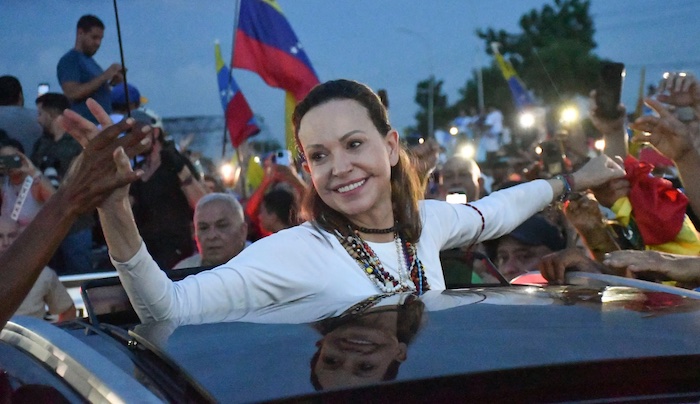
She attended Mass in the western state of Lara before travelling towards the capital, Caracas, in a convoy accompanied by cheering supporters. Images showed her greeting people from the sunroof of a car as crowds gathered along the route.
In another post, Machado described the gathering in Caracas as a moment of reunion and called for the release of political prisoners and freedom for Venezuela.
Her return follows a turbulent period in the country’s politics. Machado left Venezuela to accept the Nobel Peace Prize in Norway after spending her final days in the country in hiding. She had previously made several unsuccessful attempts to return, according to an adviser who spoke in September.
US credits reconciliation talksUS Secretary of State Marco Rubio welcomed the circumstances surrounding Machado’s return, crediting US-supported reconciliation talks for helping create the conditions for her safe arrival.
“The conditions allowing for the safe return of Ms Machado to Venezuela is the direct result of the US supported reconciliation talks,” Rubio wrote on X.
He said the talks had already led to the release of hundreds of political prisoners and the return of hundreds of opposition figures from exile.
Rubio urged political groups to support the process, describing it as an opportunity to secure free and fair elections and establish lasting democratic institutions.
However, the precise terms of the talks and their implications for Venezuela’s political transition remain important questions.
US President Donald Trump said on Sunday that he was unaware of the details of Machado’s return but expressed hope for her safety.
“I think she’s a very nice woman,” Trump told reporters, adding that Machado had given him her Nobel Prize medal.
A disputed election and an uncertain futureMachado emerged as a leading opposition figure after winning an opposition primary in 2023 by a wide margin. However, Maduro’s government barred her from contesting the 2024 presidential election, citing alleged legal violations. Machado rejected the accusations as politically motivated.
Her ally, Edmundo González, subsequently ran against Maduro.
Venezuela’s electoral authority declared Maduro the winner, but the opposition disputed the result and published voting records that it said showed González had won. The authorities did not release detailed official tallies to substantiate their announcement.
Maduro was removed from Venezuela by US forces in January 2026 and is being held in New York, where he faces US criminal charges. He has pleaded not guilty.
Following Machado’s return, González welcomed her arrival and said he intended to join her in Venezuela to advance the country towards freedom.
A spokesperson for Machado described the development as an important step towards a democratic transition and called for free, fair and verifiable presidential elections.
Nobel Prize controversyMachado’s return also follows a controversial visit to the White House in January, when she presented Trump with her Nobel Peace Prize medal.
The Norwegian Nobel Committee has clarified that a Nobel Prize cannot be revoked, shared or transferred to another person. Machado’s gesture therefore did not make Trump the Nobel laureate.
For Venezuela’s opposition, Machado’s return offers an opportunity to regroup after a prolonged period of political uncertainty. But her next steps, the government’s response and the prospects for credible elections remain unclear.
Her arrival has brought supporters back into the streets. Whether that momentum leads to lasting political change will depend on what follows.