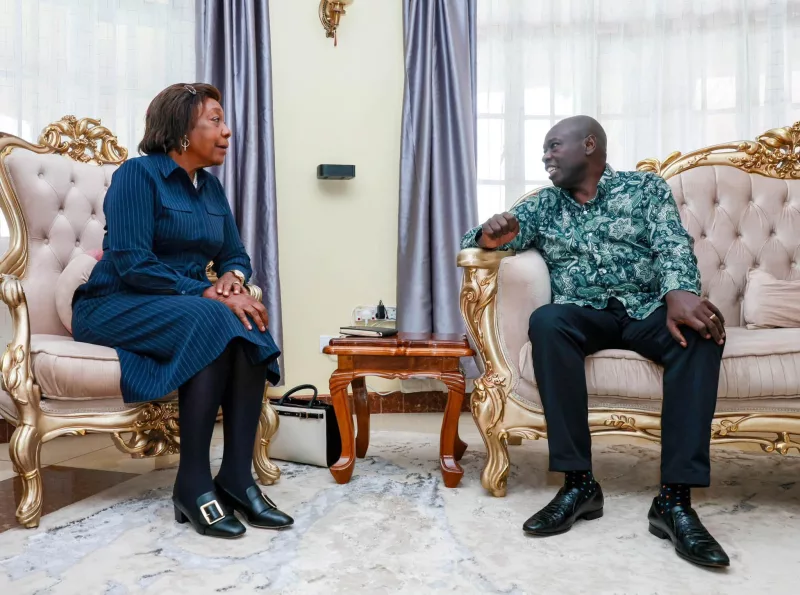
Former Deputy President Rigathi Gachagua is looking to Kenya’s political history for lessons ahead of the 2027 General Election. On Tuesday, November 3, he hosted veteran politician Charity Ngilu at his Wamunyoro residence in Nyeri County.
The discussions centred on the National Rainbow Coalition (NARC), the alliance that brought together opposition forces and ended KANU’s long hold on power in 2002.
For Gachagua, who leads the Democracy for the Citizens Party (DCP), the meeting offered an opportunity to learn from one of the politicians involved in that historic political realignment. He hopes similar unity can be achieved among opposition leaders preparing for the next election.
Ngilu’s Role in the NARC Story
After the meeting, Gachagua described Ngilu as the “Iron Lady of Kenyan politics” and credited her with helping shape the NARC project alongside former President Mwai Kibaki and the late Michael Kijana Wamalwa.
He said the former Kitui governor had explained how negotiations were conducted and how different political interests were brought together behind one presidential candidate.
“This morning, I benefited greatly from Hon. Ngilu’s wisdom as she took me through how NARC was crafted and implemented,” Gachagua said.
He added that the discussions covered strategies that could be applied to the current opposition’s efforts to challenge the Kenya Kwanza administration.
Gachagua also linked the lessons to his stated commitment to fighting corruption and impunity. He said the meeting had strengthened his understanding of what would be required to build a united political front.
The 2002 Election That Changed Kenya
NARC was formed ahead of the December 2002 General Election, when opposition parties united behind Kibaki against KANU’s candidate, Uhuru Kenyatta.
The alliance brought together leaders and political groups that had previously competed against one another. Its formation followed divisions within KANU after then President Daniel arap Moi endorsed Kenyatta as his preferred successor.
Kibaki won the election with more than 60 per cent of the presidential vote, ending KANU’s uninterrupted 39-year rule since independence. NARC also secured a parliamentary majority.
The victory became a defining example of opposition cooperation. It also demonstrated the importance of agreeing on a presidential candidate before an election.
However, NARC’s later internal divisions showed that winning together did not necessarily guarantee lasting political unity. Disagreements over power-sharing and governance eventually strained the coalition.
Gachagua Wants One Opposition Candidate
Gachagua believes the same broad approach could be used in 2027. He has repeatedly called on opposition leaders to set aside individual ambitions and agree on a single presidential candidate.
“We have a 2002 moment, and our promise is that we shall identify one presidential candidate who will win by a landslide,” he said.
The statement reflects his push for a joint opposition ticket against President William Ruto. However, the process of identifying a flagbearer and agreeing on how a coalition would operate remains a major challenge.
The meeting with Ngilu is part of a wider series of consultations involving opposition figures. Gachagua has also held engagements with Wiper leader Kalonzo Musyoka and politicians associated with the Linda Mwananchi Movement, led by Nairobi Senator Edwin Sifuna.
Unity Remains the Biggest Test
The opposition’s current discussions come amid questions about leadership, political interests and the distribution of power within a possible coalition.
The 2002 experience offers useful lessons, but the political conditions are different. A common candidate would need the backing of several parties and leaders with their own support bases and ambitions.
Gachagua has expressed confidence that an agreement can be reached. Whether the consultations will produce a formal alliance remains to be seen.
For now, his meeting with Ngilu signals an effort to draw on the experience of a previous generation of coalition builders. The real test will be whether those lessons can be turned into a workable political agreement before Kenyans head to the polls in 2027.