A united message has been sent to North Korea by the United States, South Korea and Japan. The three countries have renewed their demand for the country’s complete denuclearisation.
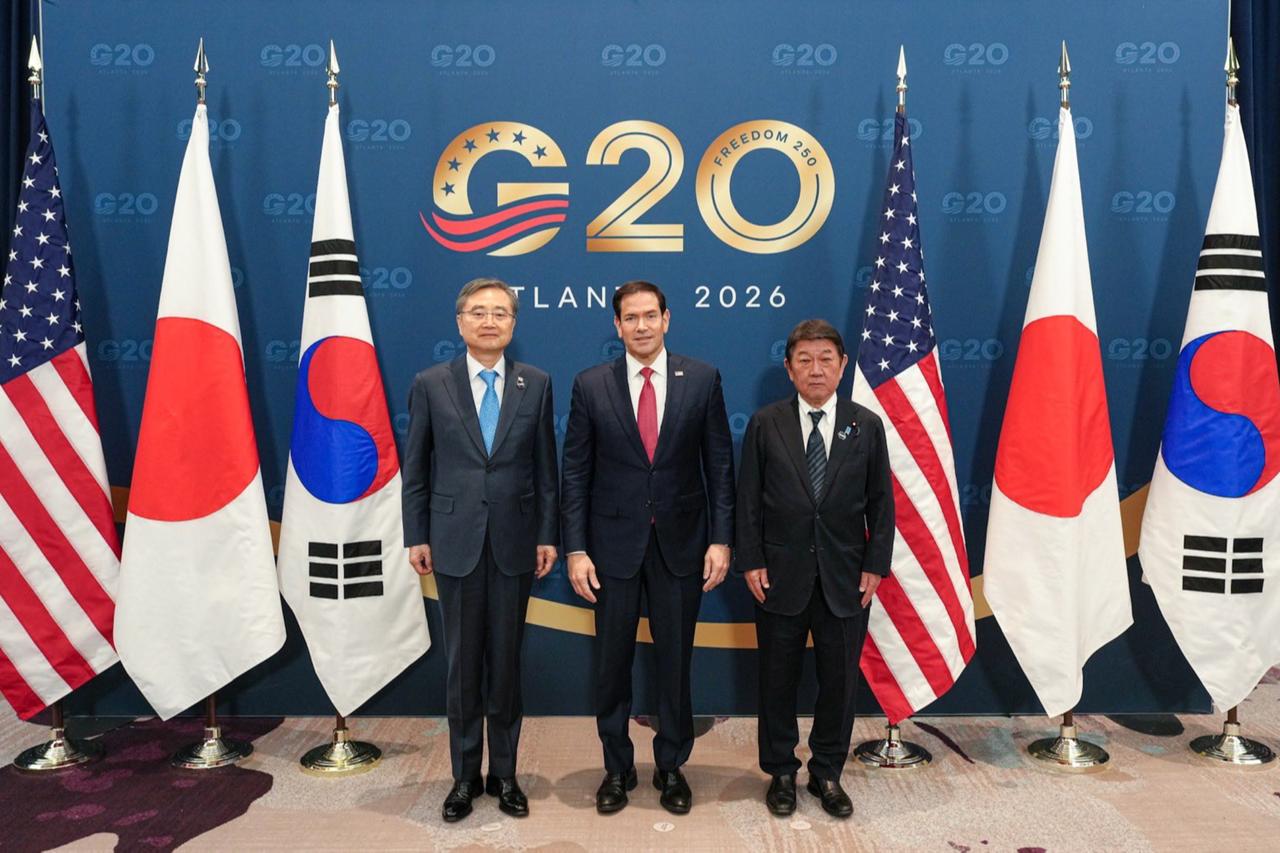
The position was reaffirmed on Friday, October 30, during talks held on the sidelines of the G20 Foreign Ministers’ Meeting in Atlanta, Georgia.
The discussions came as fresh speculation emerged over a possible meeting between US President Donald Trump and North Korean leader Kim Jong Un next month.
Three Nations Renew Their Position
The talks were attended by US Secretary of State Marco Rubio, South Korean Foreign Minister Cho Hyun and Japanese Foreign Minister Toshimitsu Motegi.
According to the US State Department, a firm commitment to North Korea’s denuclearisation was reaffirmed. The full implementation of United Nations Security Council resolutions was also supported.
The resolutions include restrictions on activities that generate money for Pyongyang’s nuclear and ballistic missile programmes.
The work of the Multilateral Sanctions Monitoring Team was also commended. The team has been tasked with documenting violations and efforts to evade international sanctions. (US State Department)
The three ministers also called for peace and stability across the Taiwan Strait. Wider security and economic cooperation in the Indo-Pacific were discussed.
Trump Signals Interest in Talks
The renewed commitment comes as Trump continues to express interest in meeting Kim.
A possible encounter has been discussed ahead of the Asia-Pacific Economic Cooperation (APEC) summit in China next month. However, no meeting has been confirmed.
Trump previously held three meetings with Kim during his first presidency. The encounters raised hopes of a diplomatic breakthrough, but no lasting agreement on denuclearisation was reached.
Last year, Trump described North Korea as “sort of a nuclear power”. He also expressed a willingness to resume talks with its leader.
Those remarks marked a shift in tone from Washington’s longstanding position. The US has continued to call for the elimination of North Korea’s nuclear weapons.
Pyongyang Rejects Disarmament
North Korea has repeatedly rejected demands to surrender its nuclear arsenal. Its government has declared the country’s nuclear status permanent and irreversible.
On Saturday, Pyongyang criticised a statement issued by countries monitoring international sanctions.
It maintained that Western sanctions would not change its position as a nuclear-armed state.
The country has continued to develop its nuclear and ballistic missile capabilities despite years of international restrictions.
Its growing ties with China and Russia have also added complexity to efforts to bring it back to negotiations.
South Korea Weighs a Different Approach
South Korean President Lee Jae Myung has repeatedly offered to hold talks with Pyongyang without preconditions.
In September, he suggested that a freeze on North Korea’s nuclear programme could be considered as an initial step. Sanctions relief could then form part of wider negotiations.
The proposal has attracted criticism. Opponents argue that a freeze could allow North Korea to retain its existing weapons while gaining economic concessions.
There are also concerns that such an arrangement could weaken the long-standing goal of complete denuclearisation.
China’s position has added to the uncertainty. Analysts have pointed to the absence of a clear denuclearisation reference in statements following recent meetings between Kim and Chinese President Xi Jinping.
A Difficult Road to Agreement
The latest meeting has shown that Washington, Seoul and Tokyo remain aligned on their stated goal. But a major gap remains between that position and Pyongyang’s refusal to disarm.
Any renewed talks would therefore face difficult questions. These include sanctions, security guarantees and the future of North Korea’s nuclear programme.
For now, the three allies have reaffirmed their position. Whether dialogue can produce progress remains uncertain.
A possible Trump-Kim meeting could reopen diplomatic channels. But no agreement has yet been reached, and North Korea has given little indication that it is ready to abandon its nuclear weapons.