Kenyan nationals are among those under investigation in a major student financial aid fraud scheme in the United States, where authorities have charged five people and seized more than $750,000 (approximately KSh97 million) in cryptocurrency.
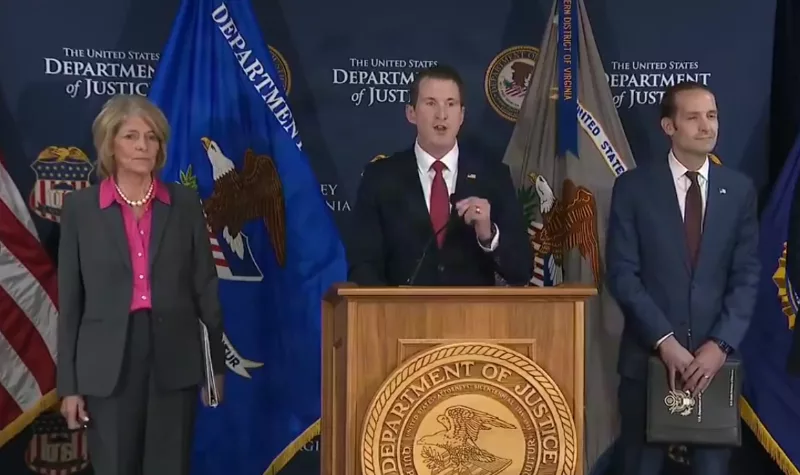
The US Department of Justice announced the charges on Thursday, October 29, following investigations under Operation Ghostbusters, a nationwide crackdown on individuals accused of stealing American identities to obtain government-funded student loans and grants.
The alleged scheme involved creating fictitious students, enrolling them in American colleges and universities and collecting financial aid despite the individuals never attending classes.
US Assistant Attorney General Colin McDonald said the first enforcement action targeted defendants operating across Nebraska, Virginia and New Jersey, with alleged links to associates in Kenya.
“Whether you are in Nebraska, New Jersey, Virginia, or Nairobi, we will pursue you,” McDonald said.
He described the investigation as an effort to protect American taxpayers and students whose personal information had allegedly been stolen.
How the alleged fraud worked
According to investigators, the suspects used stolen personal information belonging to American citizens to submit fraudulent applications through the Free Application for Federal Student Aid (FAFSA).
The applications were used to register fictitious students in educational institutions.
After the government released financial assistance, the money was allegedly channelled through American bank accounts controlled by individuals acting as intermediaries.
Some of the funds were then transferred to associates in Kenya.
Investigators also found that artificial intelligence tools were allegedly used to create coursework and attendance records to make the fictitious students appear active.
The wider scheme is believed to have operated since at least 2021, with the Justice Department estimating that losses could exceed $200 million (approximately KSh26 billion).
Kenyan national charged in Nebraska
One of the cases involves Francis Mogambi, a Kenyan citizen indicted by a federal grand jury in Nebraska on October 19.
He faces five counts of theft of government money and five counts of aggravated identity theft.
Prosecutors allege that between November 2025 and May 2026, Mogambi worked with associates in Kenya to obtain stolen American identities and use them to enrol unsuspecting individuals in educational institutions.
The indictment further alleges that he redirected federal student aid payments, retained 30 per cent of the proceeds and sent the remainder to his alleged co-conspirators in Kenya.
Mogambi was arrested and detained pending trial.
The Justice Department also cited court documents alleging that he received approximately $2,000 weekly and attempted to recruit another person into the operation.
The Nebraska case involves an estimated $20,000 in intended losses.
Virginia case involves $1.4 million
A separate investigation in Virginia involves another Kenyan national who was indicted on October 21.
According to prosecutors, the suspect allegedly received more than 700 fraudulent student aid refund payments through multiple American bank accounts.
The deposits totalled approximately $1.44 million (about KSh187 million).
Investigators allege that at least $1.3 million was subsequently moved through thousands of wire transfers and money service transactions involving accounts in the United States and Kenya.
The indictment in the Virginia case remains under seal, and the defendant's identity has not been publicly disclosed in the Justice Department announcement.
Three charged in New Jersey
In New Jersey, three defendants, Mabed Patricia Utate-Alberto, Patricia Arisleydi Perez and George Arturo Alfau Mendez, were arrested over an alleged scheme involving more than $1 million in federal student assistance.
Prosecutors accuse the three of working with individuals based in Kenya to obtain money through fraudulent student aid applications.
The defendants allegedly received the funds through American bank accounts before transferring them overseas after taking their share.
The money was reportedly sent to Kenyan associates linked to a purported safari company.
US authorities say two alleged Kenyan accomplices have been identified and that prosecutors intend to pursue charges as the investigation progresses.
The New Jersey case carries an estimated $1.5 million in intended losses.
More than 830,000 suspicious accounts identified
Beyond the five defendants, investigators have identified 830,840 potentially fraudulent Federal Student Aid identification accounts associated with nearly $130 million in suspected fraud.
The Justice Department has recommended that the Department of Education disable the accounts to prevent further losses.
The FBI has separately identified more than $32 million in losses from similar ghost-student schemes, with additional amounts suspected.
Assistant Director Heith Janke said investigators would continue working with federal agencies to trace the money and identify those responsible.
He said the FBI would follow the evidence and pursue individuals seeking to exploit government financial assistance programmes.
Kenya-US cooperation
Kenya's Directorate of Criminal Investigations (DCI), Asset Recovery Agency (ARA) and Office of the Director of Public Prosecutions (ODPP) are among the local agencies assisting the American investigation.
The Justice Department confirmed that cooperation with Kenyan law enforcement helped investigators seize more than $750,000 from a cryptocurrency account belonging to a Kenyan national linked to the alleged scheme.
The seizure was described as the first international asset recovery of its kind in the history of the department's National Fraud Enforcement Division.
In September, American investigators visited Kenya to discuss cooperation on extradition, prosecution and the recovery of funds allegedly stolen from US taxpayers.
Operation Ghostbusters now has more than 40 active cases across 26 FBI field offices and over 20 US attorneys' offices.
The investigation remains ongoing, with American authorities indicating that further charges and asset recovery efforts could follow.
The charges announced so far relate to separate cases and do not establish that the defendants are guilty. All those charged are presumed innocent unless proven guilty in court.