
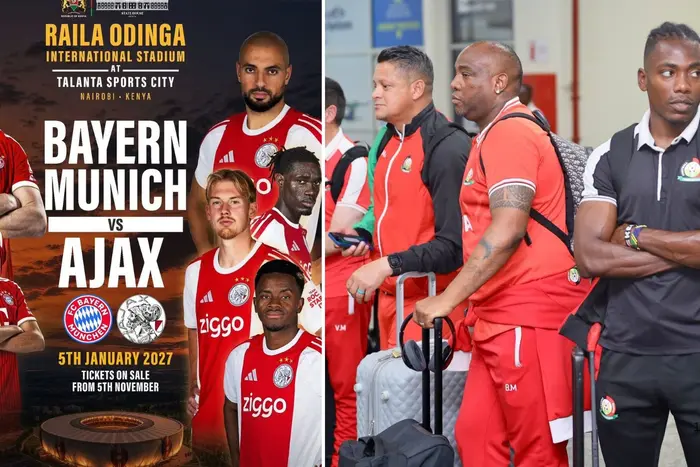
Kenya is preparing to host two European football giants. Bayern Munich and Ajax Amsterdam are expected in Nairobi in January 2027.
The match has generated excitement. But it has also raised an uncomfortable question: why is so much money being committed to foreign clubs while local players have struggled to receive their allowances?
President William Ruto announced the fixture on Wednesday. It is scheduled for January 5, 2027, at the newly opened Talanta Stadium.
The reported appearance fees have become the centre of the debate. Bayern are expected to receive €5 million, about KSh727 million. Ajax are reportedly set to earn another €2.5 million, although that figure has not been officially confirmed.
Together, the reported payments could approach KSh1.1 billion.
A Costly Opening Match
The fixture is expected to open the 60,000-seat Raila Odinga International Stadium, formerly known as Talanta Stadium. The venue is being prepared for the 2027 Africa Cup of Nations, which Kenya will co-host with Uganda and Tanzania.
For Bayern, the trip will reportedly attract an appearance fee of €5 million. The figure was reported by German football sources and cited by several Kenyan outlets.
Ajax’s reported €2.5 million fee remains unconfirmed. No detailed public breakdown of the match budget has been released. The final cost could also include flights, accommodation, security and other logistical arrangements. President Ruto has said the event will be funded through corporate partnerships and a commercial model designed to generate its own revenue.
He argued that major sporting events could attract private investment and create opportunities for Kenyans. However, the expected sponsorship income, ticket revenue and other projected returns have not yet been publicly detailed.
That leaves questions about who will ultimately meet the costs and how the financial benefits will be measured.
Harambee Stars’ Allowance Dispute
The criticism has been fuelled by recent problems involving Harambee Stars.
In September, players refused to train ahead of their 2027 Africa Cup of Nations qualifier against Eritrea. They demanded outstanding allowances for previous national team assignments.
Football Kenya Federation officials said players were seeking KSh80,000 each for matches against Senegal and Lesotho. Coach Benni McCarthy also raised concerns about payments owed across several training camps.
The Ministry of Sports later announced that outstanding payments had been cleared. But some players said the amounts received were below what they expected.
Striker Ryan Ogam confirmed that some payments had reached players’ accounts, while expressing dissatisfaction with the rates paid. The episode exposed the difficulties faced by national team players who have had to demand payments before fulfilling international assignments.
Harambee Starlets Also Raised Concerns
The women’s national team faced a similar dispute in July.
Harambee Starlets players protested at the FKF offices over unpaid allowances ahead of their preparations for the Women’s Africa Cup of Nations.
The Ministry subsequently announced the release of KSh20 million to be shared between the senior and junior women’s teams. The players had threatened to boycott their training camp if the outstanding dues were not settled.
The repeated disputes have raised questions about how national team finances are managed and why players have had to push for payments.
A Debate About Kenya’s Football Priorities
The Bayern–Ajax match could bring international attention to Kenya. It may also give local fans an opportunity to watch two of Europe’s most recognised clubs.
But the excitement has been accompanied by demands for greater transparency. Critics want the government to explain the full cost, the source of funding and the expected returns.
The comparison with Harambee Stars has become particularly difficult to ignore. While millions are reportedly being committed to attracting foreign clubs, local players have recently faced delays in receiving relatively modest allowances.
The two issues are not necessarily funded through the same arrangements. The President has described the friendly as a commercially supported event, while national team allowances involve the Ministry of Sports and football authorities.
Even so, the concerns remain relevant. Kenyan football needs both international exposure and reliable support for its own players.
The January fixture will therefore be judged on more than the names on the teamsheet. Its financial transparency, commercial returns and lasting benefits to local football will also matter.


