
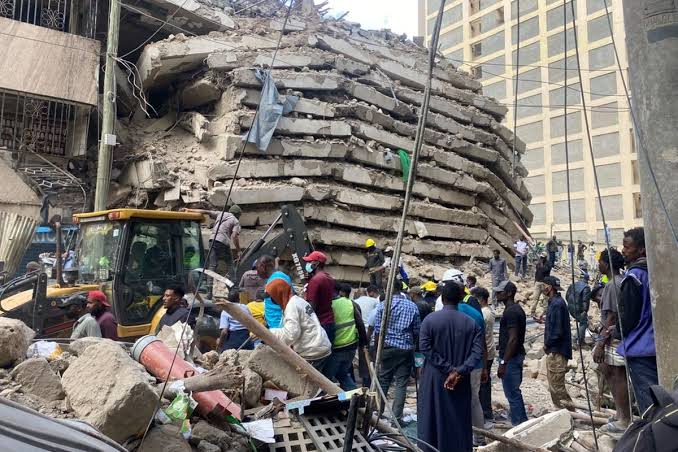
The phrase “kuanguka chapati” brought a brief smile to a tense scene in Eastleigh. But the engineering term behind the joke describes a dangerous form of building failure.
During a media briefing following Friday’s collapse, structural engineer Robert Otieno Ogallo explained that the structure appeared to have suffered what is known as a pancake collapse. After Citizen TV anchor Lulu Hassan asked for a simpler explanation, the failure was described in Swahili as falling like a chapati.
The light-hearted comparison offered a moment of clarity amid a serious rescue operation. Several people were feared trapped beneath the debris of the multi-storey building, which collapsed along 9th Street in Eastleigh on October 23, 2026.
What Is a Pancake Collapse?
A pancake collapse occurs when several floors fall and stack on top of one another. The slabs may remain partly intact, but the structure between them is crushed or severely damaged.
The pattern resembles a stack of pancakes or chapatis pressed together. The spaces between floors can become narrow, leaving little room for trapped occupants or rescuers. However, the size and location of any surviving gaps depend on how the building has failed.
How Does It Happen?
A collapse may begin when a vital structural component fails. This could be a supporting column, a wall or a connection between a floor and its supports.
Once support is lost, the floor above may fall onto the level below. The impact can overload the lower floor, causing it to fail as well.
If the failure spreads from one level to another, a progressive collapse can follow. Several floors may then come down in quick succession, leaving layers of concrete and debris piled together.
The precise sequence varies from one incident to another. The cause cannot be established from the final shape of the rubble alone.
Why Are Rescue Operations Difficult?
The tightly packed slabs can make access to trapped people extremely difficult. Heavy concrete, twisted steel and unstable debris may block possible routes into the structure.
Specialist rescue teams must assess the risks before cutting through slabs or moving heavy sections. Equipment such as concrete cutters, lifting machinery and temporary supports may be required.
Moving one section without proper precautions can destabilise another part of the wreckage. Rescue work must therefore be carried out carefully, with the risk of further collapse considered throughout the operation.
Does Every Collapse Leave No Survival Space?
No. Although pancake collapses can leave very little room, it would be inaccurate to say that survivors have no chance of survival.
Some sections may remain supported by broken columns, beams or other debris. These can create voids in which people may survive. The spaces vary in size and stability, and their existence cannot be assumed until the site has been assessed.
Other collapse patterns, including lean-to and V-shaped failures, can leave different kinds of gaps. No single pattern guarantees survival or makes rescue impossible. Each site must be examined on its own conditions.
What Could Have Caused the Eastleigh Collapse?
The term pancake collapse describes a pattern of failure. It does not, by itself, explain why a building came down.
Possible causes of structural failure include design deficiencies, poor materials, construction errors, overloading or failures in critical connections. These are general possibilities, not established findings about the Eastleigh incident.
The National Construction Authority confirmed that the project was registered in July 2025 and identified the developer, contractor, architect and structural engineer listed in its records. Registration alone does not establish that every construction requirement was met.
Investigators will need to examine the design, construction records, materials and site conditions before the cause can be determined. Any responsibility must be established through evidence and due process.
The Questions Facing Nairobi
The collapse has renewed scrutiny of building safety and regulatory oversight in the capital. It has also raised questions about how construction projects are approved, monitored and inspected.
For families waiting for news of missing relatives, the immediate concern remains the search for survivors. For engineers and investigators, the task is to establish how the structure failed and whether warning signs were missed.
Understanding a pancake collapse can explain the dangers facing rescuers. Only a thorough investigation, however, can establish what happened in Eastleigh and why.


