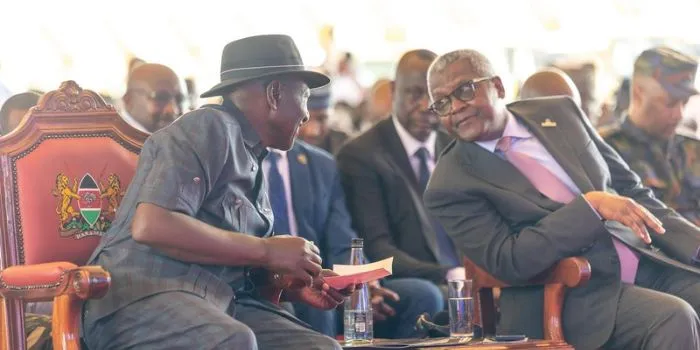
President William Ruto has defended Aliko Dangote’s purchase of a major stake in Kenya Pipeline Company (KPC). He has challenged critics to explain why the Nigerian billionaire should be barred from buying shares available on the Nairobi Securities Exchange.
“Why not?” Ruto asked on Tuesday. He was speaking during the groundbreaking of a Sh70 billion Devki cement and clinker plant in Ngaaie, Kitui County.
The President accused unnamed individuals of trying to frustrate investors. He said his government would confront those he believes are undermining Kenya’s economic progress.
The dispute has placed a major investment under public scrutiny. Questions have been raised about the sale of shares held by state-backed institutions and the government’s wider business ties with Dangote.
‘Every Kenyan Has a Right’
Dangote’s group acquired about 4.5 billion KPC shares. The stake represents 24.76 per cent of the company and was valued at roughly KSh42.5 billion.
The purchase made the group KPC’s second-largest shareholder. The Kenyan government retains a 35 per cent stake, while Uganda’s national oil company holds about 20.15 per cent.
Ruto argued that the shares had been made available through the stock market. He said the same opportunity had been open to other investors.
“Nobody has been stopped from buying the shares,” he said. “Every citizen in Kenya has a right to own any share they want to buy.”
He also said Dangote’s involvement could improve the company’s performance and increase returns for shareholders.
The President did not provide detailed financial projections to support that claim. The investment’s long-term value will depend on KPC’s performance and the returns it delivers.
Questions Over the Sale
The purchase has attracted scrutiny because some of the shares were held by state-backed institutions. These included the National Social Security Fund and the Public Servants Pension Scheme.
The institutions had invested heavily in KPC during its initial public offering earlier in 2026. The shares were later transferred in a major transaction reported at about KSh42.5 billion.
People’s Party of Kenya leader and Kiharu MP Ndindi Nyoro has questioned the circumstances surrounding the sale. He has alleged that state institutions were pressured to buy shares during the IPO before selling substantial holdings to a private investor.
Nyoro has also raised concerns about the possibility of future transactions increasing Dangote’s influence over the company. Those claims have not been independently established, and no further share sale or rights issue has been announced in the reports cited.
Treasury Cabinet Secretary John Mbadi has defended the transaction as a commercial deal between willing parties. The debate has therefore centred on both the terms of the sale and the role of public institutions in the process.
A Wider Energy Ambition
Dangote’s interest in KPC comes alongside plans for a major oil refinery in Lamu. The proposed project is expected to expand petroleum processing and distribution capacity in the region.
Ruto has presented the investments as an opportunity to strengthen Kenya’s energy infrastructure. He has also argued that major investors can help create jobs and expand economic activity.
However, critics have called for greater clarity over the government’s dealings with the Dangote Group. They have questioned whether the share purchase is connected to the proposed refinery and what the arrangements could mean for Kenya’s strategic energy assets.
No evidence presented in the cited reports establishes that the President personally benefits from Dangote’s acquisition. The allegations surrounding political influence remain contested.
Investment and Public Accountability
KPC operates a pipeline network that moves petroleum products from the coast to inland markets and neighbouring countries. Its strategic role makes ownership and oversight important questions for the public.
Ruto has maintained that investors should be allowed to participate in the market. He said the government would not allow what he described as attempts to intimidate or frustrate businesses.
The challenge now is to balance investor confidence with transparency. Clear disclosure of the transaction’s terms, the selling institutions’ returns and any future ownership changes would help the public assess the deal.
For the government, Dangote’s entry is being presented as a vote of confidence in Kenya’s economy. For critics, the key issue remains whether the transaction served the interests of the institutions that sold the shares and the wider public.
The debate is unlikely to end with the President’s defence. Its resolution will depend on the available evidence, the company’s performance and the scrutiny applied to a deal involving one of Kenya’s most important energy assets.