
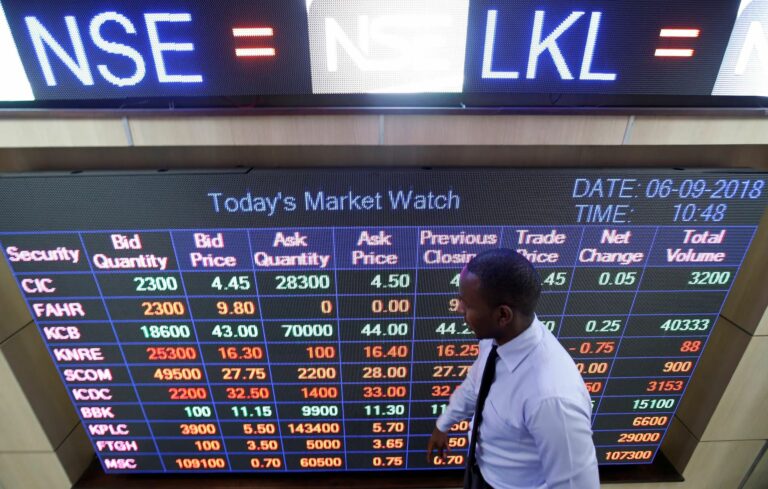
Foreign investors are pulling money out of listed companies, some shareholders are taking profits after months of strong gains, and global markets are offering competing investment opportunities.
The latest figures from the Nairobi Securities Exchange (NSE) show that the decline continued into October, following a difficult September.
According to Standard Investment Bank’s weekly market report published on 26 October 2026, the Nairobi All Share Index (NASI) fell by 2.3 per cent in the week to 23 October. The NSE 10 declined by 3.5 per cent, while the NSE 25 and NSE 20 dropped by 2.8 per cent and 1.7 per cent, respectively.
The losses followed another weak week in which all four major indices fell. Foreign investors also remained net sellers, adding to the pressure on Kenyan equities.
The central question is whether the market is undergoing a temporary correction after a strong rally or heading into a more prolonged period of weakness.
Profit-taking after months of gains
One possible explanation for the market’s recent decline is that investors are cashing in on profits made earlier in the year.
Kenyan shares recorded strong gains in the second and third quarters of 2026. Standard Investment Bank reported that the NASI rose by 9.6 per cent in the third quarter, while the NSE 20 gained 15 per cent. The NSE 25 advanced by 12.4 per cent over the same period.
After such gains, some investors may choose to sell their holdings and secure returns rather than risk losing them if prices fall further.
In an analysis published on 19 October, Business Today Kenya identified profit-taking and portfolio adjustments as factors contributing to the recent weakness. It also pointed to investors reducing medium-term positions ahead of the August 2027 general election.
When many investors sell at the same time, share prices can decline even if the underlying businesses remain relatively stable.
Profit-taking, therefore, does not necessarily mean listed companies are performing poorly. It can instead reflect a change in investors’ appetite for risk after a period of strong market performance.
Foreign investors are pulling money out
Foreign investor activity has emerged as another source of pressure on the market.
Standard Investment Bank reported net foreign outflows of US$9.4 million in the week covered by its 26 October report. Safaricom attracted the heaviest foreign selling, while Kenya Power led foreign buying.
The latest withdrawals follow a broader pattern of foreign investors reducing their exposure to Kenyan shares throughout the year.
Business Radar reported on 19 October that foreign investors had net sold approximately KSh17.79 billion worth of NSE shares since January 2026. The figure exceeded their net withdrawals for the whole of 2025.
Foreign investors play a significant role in trading some of the exchange’s largest and most actively traded companies. When they sell substantial holdings, local buyers must absorb the additional shares to prevent prices from falling further.
If demand is insufficient, share prices can decline, particularly among large companies that account for a significant share of overall market activity.
However, foreign selling does not automatically indicate that investors have lost confidence in Kenya alone. Investment decisions can also reflect currency risks, global interest rates, portfolio adjustments and opportunities elsewhere.
Global markets are competing for Kenyan investment
Kenya’s stock market does not operate in isolation. Investors can shift money between countries and asset classes in search of better returns.
That creates competition between Kenyan shares, government bonds and equities in larger international markets.
In September, Business Daily Africa reported that the NSE’s market capitalisation had fallen below KSh4 trillion amid heavy selling by foreign and local investors. The report linked the pressure partly to rising geopolitical tensions and the US 10-year Treasury yield reaching 5 per cent, its highest level since 2023 at the time.
Higher yields on US government bonds can make them more attractive to investors seeking returns without taking on the same level of risk associated with equities in emerging and frontier markets.
When investors can earn more from relatively lower-risk assets, they may demand higher potential returns before committing money to riskier markets such as Kenya.
The effect is not automatic, however. Currency movements, expectations about future interest rates and the financial health of individual companies also influence investment decisions.
For the NSE, the challenge is to attract and retain capital in an increasingly competitive global investment environment.
Election uncertainty is adding to investor caution
Kenya’s August 2027 general election is another consideration for investors deciding where to put their money.
Elections can influence market sentiment because investors may be concerned about possible changes in government policy, taxation, public spending and the broader economic outlook.
Such concerns can encourage some investors to reduce their exposure to shares or postpone new investments until there is greater clarity about the political environment.
Business Today Kenya has identified the approaching election as one factor behind portfolio adjustments at the NSE, alongside profit-taking and competition from global markets.
However, the available market data does not establish that election fears are the main cause of the current downturn.
Foreign capital outflows, the reversal of earlier share-price gains and international investment conditions provide additional explanations for the sell-off.
This distinction matters because the market could remain under pressure even if political uncertainty eases. Continued foreign selling or unfavourable global conditions could still weigh on share prices.
Investors will therefore be watching both political developments and the broader economic environment as the election approaches.
. Large transactions can distort the picture
The NSE’s latest trading figures also illustrate why headline turnover alone does not always provide a clear picture of market performance.
Standard Investment Bank reported that total market activity rose to US$348.3 million in the week to 23 October, an increase of 1,324.7 per cent from the previous week.
The sharp rise was largely driven by a KSh42 billion block trade in Kenya Pipeline Company (KPC), which accounted for 93.4 per cent of the week’s turnover. KPC shares rose by 17.2 per cent to close at KSh10.55.
A block trade involves a large transaction in a substantial number of shares. Such deals can push reported turnover sharply higher without indicating a similar increase in ordinary trading activity across the exchange.
Meanwhile, several major listed companies recorded losses during the same week. Safaricom fell by 4.6 per cent, KCB Group declined by 4.7 per cent and Equity Group lost 2.5 per cent.
The figures highlight the difference between the value of shares traded and the overall direction of the market.
A large transaction can increase turnover substantially, but it does not necessarily mean investors are broadly returning to equities or that confidence has improved.
Company earnings and market liquidity still matter
Beyond political developments and foreign investor flows, the performance of individual companies remains central to the direction of share prices.
Investors assess whether businesses can grow their revenues, control costs and maintain profits before deciding whether their shares are worth buying.
For banks, lending growth, asset quality and funding costs can influence earnings expectations. Telecommunications companies are assessed on factors such as subscriber growth, revenue and capital expenditure, while consumer-facing businesses must contend with household spending patterns and operating costs.
These are important areas to watch, although they are not, on their own, confirmed causes of the latest market-wide decline.
Market liquidity also plays a role. When trading is concentrated in a relatively small number of actively traded shares, a wave of selling can put significant pressure on prices if there are not enough buyers.
For investors, the key question is whether falling share prices reflect deteriorating company fundamentals or are mainly the result of portfolio rebalancing and changing market sentiment.
The answer may differ from one company to another.
Is the NSE entering a prolonged bear market?
The recent losses have raised questions about whether the NSE is experiencing a temporary correction or entering a longer period of declining prices.
September was already difficult for the exchange. The Star reported on 9 October that the NSE’s market capitalisation had fallen by approximately KSh96.3 billion during the month, to KSh4.12 trillion.
The continued declines in October suggest that the selling pressure has not yet fully eased.
Even so, several weeks of losses do not, on their own, establish that the market has entered a prolonged bear market. A sustained downturn would need to be assessed against a longer period of price movements, investor activity and company performance.
Investors will be watching the major indices, foreign investor flows, trading volumes, corporate earnings and wider economic conditions for signs of whether the market is stabilising.
Global interest rates and developments surrounding the 2027 general election could also influence sentiment in the coming months.
For now, the NSE’s downturn appears to reflect several overlapping pressures rather than a single cause. Profit-taking, foreign investor withdrawals, competition from global markets and election-related caution are all part of the picture.
Whether the market recovers will depend partly on whether buyers return, listed companies sustain their earnings and investors become more confident about the risks facing Kenyan equities.