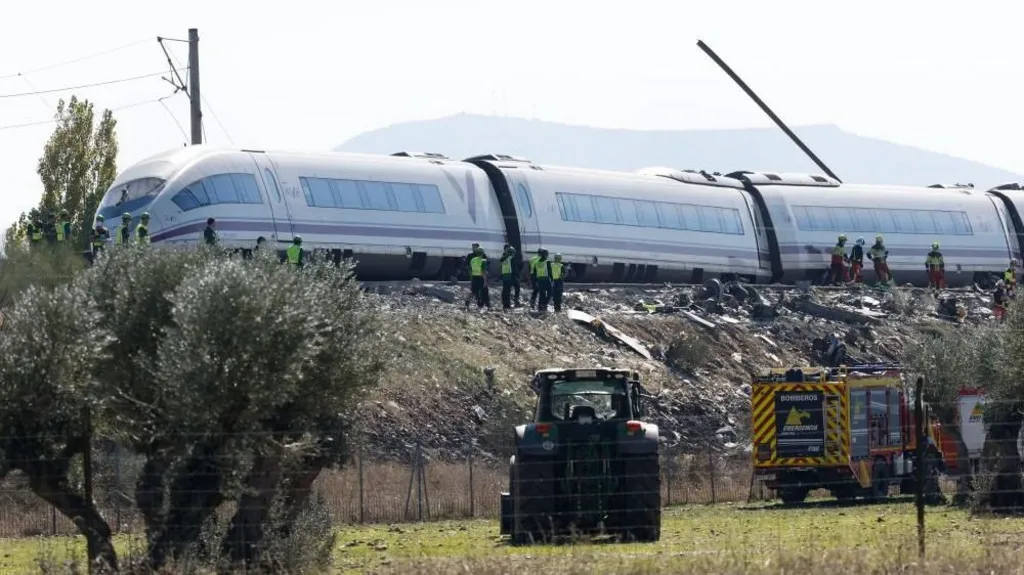
Spain began three days of national mourning on Thursday after a collision between two high-speed trains killed 68 people and injured scores, leaving families waiting anxiously for news of their loved ones.
The crash, which occurred on Wednesday in the central region of Castilla-La Mancha, is among Europe's deadliest railway disasters this century. It has also renewed scrutiny of Spain's rail safety systems following another fatal collision earlier this year.
The accident involved a train operated by state-owned Renfe and a service run by private company Iryo. According to Transport Minister Óscar Puente, the Renfe train struck the rear of the stationary Iryo train under circumstances he described as inexplicable.
Rescue workers continued searching through the wreckage overnight, using cranes to lift twisted metal and reach parts of the damaged carriages. The collision occurred on a key railway line connecting Madrid with the southern city of Seville.
For survivors, the experience was terrifying.
Josimar Medina, a 31-year-old Peruvian tourist travelling with his girlfriend, told AFP he had been asleep when the crash happened.
“I woke up and I was in the air,” he said.
Another survivor, Pablo Mejia, 42, escaped with head injuries after changing seats shortly before the collision. He described a scene of destruction, with passengers thrown across the carriage, seats torn from their fittings and luggage scattered everywhere.
“I think I've been born again,” he said.
Families Wait for News
In the nearby village of Urda, a school was turned into a support centre where relatives could seek information about missing family members. Red Cross workers offered psychological support as distressed families gathered amid a heavy presence of police and journalists.
Carmen Garcia, a Red Cross psychologist, warned that the coming hours would be difficult for those affected.
“Every person will manage it in their own way,” she said, describing relatives who were shocked, angry, sad or deeply worried.
Spain's Civil Guard opened offices in Madrid, Toledo, Córdoba and Seville to collect DNA samples and help identify victims. Blood donation centres were also established in Madrid and Castilla-La Mancha.
José Miguel Fernández, a parish priest in Urda, said being present for grieving families mattered more than finding the right words.
“What matters most is being with the victims' relatives, that they feel the closeness,” he said. “Words at a time like this are pointless, but a hug helps.”
He described the crash site as a scene of devastation, uncertainty and despair.
Questions Over Rail Safety
The disaster has raised questions about how the trains came to collide and whether warnings about the track conditions were properly addressed.
Puente said an automatic control system had failed along a 69-kilometre stretch of railway, forcing trains in the area to stop. He questioned the decision by the control centre to resume traffic before the reported problem had been properly resolved.
“The control centre had more than enough time to verify the error, and they did not fix it,” he said.
The circumstances surrounding the failure and the decision to restart services will be central to the investigation. The minister's account has not, by itself, established the cause of the collision or individual responsibility.
The crash follows a separate high-speed rail disaster in the southern region of Andalusia in January, when 46 people died after one train derailed and crossed onto an adjacent track. That investigation remains ongoing.
The two incidents have intensified scrutiny of Spain's railway network and the government's handling of rail safety.
The latest tragedy comes at a politically sensitive time for Prime Minister Pedro Sánchez, whose Socialist government faces an early general election on November 29, according to the report.
For now, the national mourning period offers Spain a moment to remember those killed while investigators work to establish what went wrong and families wait for answers.