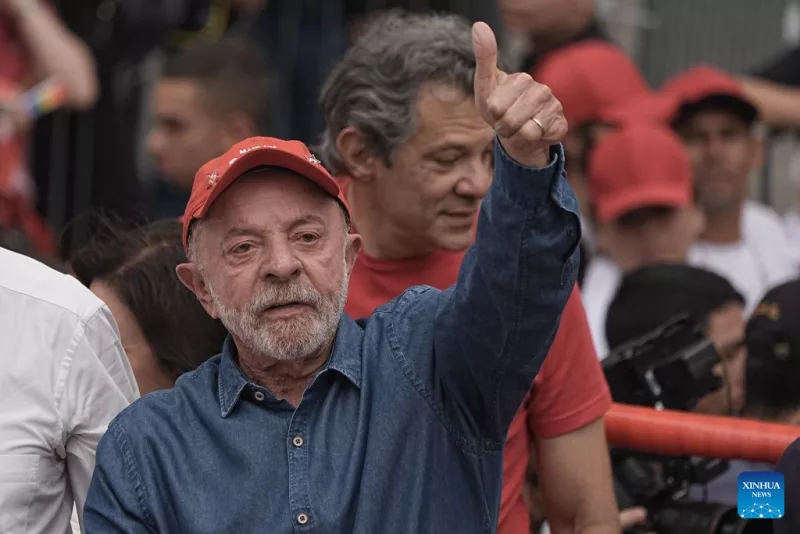
Brazilian President Luiz Inácio Lula da Silva has won a fourth presidential term, defeating right-wing challenger Flávio Bolsonaro in a closely contested election that exposed deep divisions in Latin America’s largest country.
Lula secured 51.79 per cent of the vote against Bolsonaro’s 48.21 per cent, according to Brazil’s Superior Electoral Court. The result gives the veteran left-wing leader another term, but his narrow victory leaves him facing a divided electorate and a legislature with strong conservative representation.
Bolsonaro, a senator and the son of former president Jair Bolsonaro, has refused to accept the outcome. He has called for the election to be annulled, arguing that a decision to extend voting hours by two hours made the result questionable.
However, both campaigns had requested an extension for different reasons. Lula’s team cited transport difficulties that prevented some voters from reaching polling stations, while Bolsonaro’s campaign pointed to adverse weather conditions.
The court’s president, Kassio Nunes Marques, subsequently confirmed Lula’s victory and said the extension had not compromised the electoral process.
A remarkable political comeback
Lula’s victory marks a dramatic reversal. Bolsonaro finished ahead in the first round on 4 October, raising doubts about the incumbent’s chances of securing another term.
In the weeks that followed, Lula’s campaign gained momentum through public rallies, social media outreach and efforts to bring more voters to the polls.
The result also makes Lula the first Brazilian president to win four presidential elections since the country returned to democratic rule. He previously served two terms from 2003 to 2010 before returning to office in January 2023.
At 80, the former metalworker now faces another demanding term, with his inauguration scheduled for 5 January 2027.
Addressing supporters in São Paulo, Lula thanked young voters, women, teachers and workers who backed his campaign. He described the result as a victory for democracy and promised to listen more closely to the Brazilian people.
“This, my fourth term, will be the best of any president in the history of this country,” he said.
A divided country and a difficult Congress
Despite the celebrations, the result highlights the strength of Brazil’s political divisions. Nearly half of voters backed Bolsonaro, reflecting continued support for the conservative movement associated with his father.
Lula will also have to negotiate with a Congress in which right-wing parties have gained considerable influence. Passing legislation on economic policy, social welfare and environmental protection could therefore require difficult political compromises.
His challenge will be to turn his campaign promises into practical policies while persuading voters who remain sceptical of his leadership.
Foreign policy and the Amazon
The election carries implications beyond Brazil’s borders. Lula has defended the country’s independence in its dealings with Washington and has maintained closer relations with China than many conservative leaders in the region would prefer.
US President Donald Trump’s administration has sought to strengthen American influence across Latin America. Bolsonaro had promised closer alignment with Washington, while Lula argued that Brazil should determine its own foreign policy.
The result is also significant for environmental policy. Lula has presented himself as a defender of the Amazon rainforest, although some environmentalists have criticised his support for oil exploration near the mouth of the Amazon River.
They had feared that a Bolsonaro victory could have weakened environmental protections and increased pressure from mining and agricultural interests.
The next test for Lula
Lula’s win offers a reprieve for Brazil’s left, but it does not resolve the country’s political tensions.
Bolsonaro’s demand for an annulment adds uncertainty to the aftermath of an already contentious campaign. Electoral law experts cited by BBC News Brasil have suggested that overturning the result would face significant legal obstacles, particularly because both campaigns requested an extension of voting hours.
Lula must now build enough support in Congress to govern effectively while addressing the concerns of voters who chose his opponent.
His victory was historic. Whether it produces a more united Brazil will depend on what he does next.