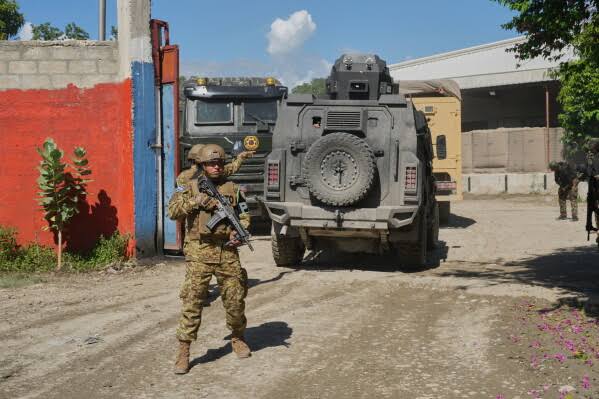
Haiti has formalised a security cooperation agreement with El Salvador. The move comes as thousands of people took to the streets of Port-au-Prince to welcome Salvadoran troops deployed to fight armed gangs.
The agreement was approved by Haiti’s Council of Ministers on Tuesday, November 17, according to the Haitian government. It was described as a new step in strengthening relations between the two countries.
The development has drawn attention to President Nayib Bukele’s growing role in Haiti’s security crisis. His government has sent more than 2,000 troops to support operations against gangs that have taken control of large parts of the capital.
Demonstrations Welcome Salvadoran Troops
Thousands of Haitians gathered in Port-au-Prince and other areas on Tuesday to show support for the deployment.
Signs thanking Bukele were displayed during the demonstrations. Some participants praised the Salvadoran forces for responding to a crisis that has left communities living under the threat of kidnapping, murder and extortion.
One demonstrator, who declined to be identified for security reasons, urged Bukele to continue supporting Haiti.
“We are asking President Bukele to ignore the detractors and to continue supporting Haiti,” the protester told AFP.
The public response reflects the desperation of residents seeking relief from years of gang violence. However, support for the deployment does not necessarily settle questions about its command, legal framework or long-term objectives.
Why Bukele Sent More Than 2,000 Troops
The Salvadoran deployment followed the disappearance of four Salvadoran aviation technicians on October 18. The personnel had been serving with the UN-backed Gang Suppression Force (GSF) when they were reportedly abducted during a gang ambush in Port-au-Prince.
Bukele subsequently announced a rescue operation. More troops were sent to Haiti, with the mission also extending to operations against armed gangs.
The Salvadoran forces are operating separately from the GSF in most cases, according to the United Nations. Their precise deployment arrangements and duration have not been publicly disclosed.
The four missing personnel remain unaccounted for.
Operations Raise Human Rights Concerns
Haitian authorities have welcomed the additional support. The deployment has also been linked to efforts to recover areas held by gangs.
Salvadoran forces have reportedly worked alongside Haitian police during operations in the capital. One high-profile operation involved the recapture of a football stadium previously controlled by armed groups.
But concerns have been raised about the growing number of security forces operating in Haiti. These include the national police, the Haitian army, the UN-backed GSF, private security personnel and Salvadoran troops.
Questions remain over how the different forces coordinate their operations and who is responsible for monitoring their conduct.
On November 17, the UN human rights office called on all security forces to protect civilians. It stressed that lethal force should be used only as a last resort. The warning came amid reports of serious abuses by gangs and risks linked to intensified security operations.
Haiti Faces a Deepening Security Crisis
The scale of the crisis remains severe. The UN recorded 4,595 people killed and 2,050 injured through armed violence between January and October 2026. Between July and September alone, at least 1,167 people were killed and 459 injured. The figures include casualties from gang violence and security operations.
Gangs continue to control large areas of Port-au-Prince and surrounding communities. Murder, kidnapping, sexual violence and forced recruitment have further weakened public safety.
Haiti, the poorest country in the Americas, has also faced prolonged political instability. The security crisis has disrupted daily life and displaced thousands of people.
Haitians Abroad Also Welcome the Intervention
Support for the Salvadoran deployment has also been expressed by members of the Haitian diaspora.
At a football match between Haiti and the United States in Miami over the weekend, some Haitian supporters waved Salvadoran flags and chanted Bukele’s name.
One fan, Guito Ledix, 41, said he welcomed the intervention because he believed it offered hope of ending gang violence.
Another supporter, Stephanie Jeanty, 28, said the deployment had eased some of her concerns about relatives still living in Haiti. She nevertheless said she was not yet ready to return home. Their reactions reflect the anxiety of families separated by insecurity and the desire for lasting improvements.
Security Deal Faces a Difficult Test
The agreement with El Salvador marks a new stage in Haiti’s efforts to restore security. It also raises questions about how foreign forces will operate alongside national institutions and international missions.
The immediate priorities include finding the missing Salvadoran personnel, protecting civilians and reducing gang control.
However, security operations alone may not resolve Haiti’s wider problems. Lasting progress will also depend on stronger state institutions, accountable policing and a credible political process.
For many Haitians, the arrival of Salvadoran troops has offered a measure of hope. The real test will be whether the intervention delivers lasting security without exposing civilians to further harm.