Ghana’s decision to spend more than $60 million on a new presidential jet has triggered public criticism, with opposition politicians questioning whether the purchase should have been a priority as many citizens continue to face economic difficulties.
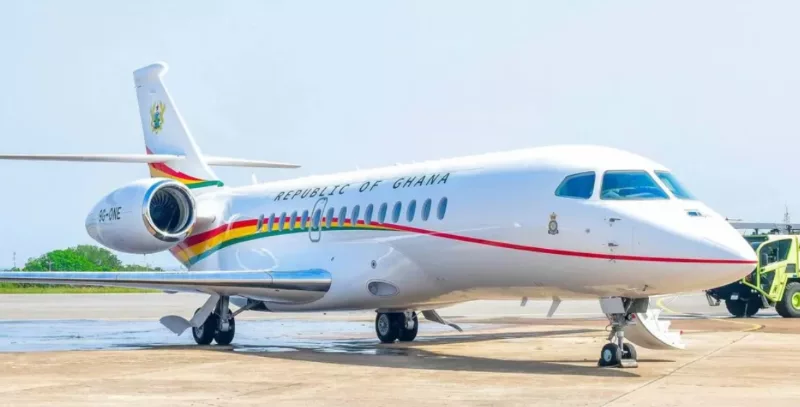
The French-made Dassault Falcon 6X arrived in Ghana on Monday, 16 November 2026, following a procurement agreement valued at US$60.68 million.
The aircraft was received by the Ghana Air Force in Accra, marking a new chapter in the country's presidential air transport arrangements. However, its arrival has reopened a political debate over government spending, economic recovery and the use of public funds.
President John Mahama's administration has defended the acquisition, arguing that the new aircraft is necessary to replace an ageing presidential jet that has experienced repeated technical problems.
The purchase has nevertheless drawn criticism from opposition lawmakers, who say the government should explain why such a significant expenditure was necessary at a time when unemployment and the cost of living remain major concerns.
Opposition questions government's priorities
Samuel Abu Jinapor, a Member of Parliament for Damongo and a senior opposition figure, has challenged the government's decision, questioning its consistency on presidential aircraft purchases.
He recalled that the National Democratic Congress (NDC), which now leads the government, had previously opposed proposals to acquire a new presidential jet while in opposition.
"What was unacceptable in opposition cannot suddenly become acceptable in government merely because the occupants of power have changed," Jinapor said.
He has also demanded greater transparency over the procurement process, including the contract, financing arrangements and the total cost to taxpayers.
The opposition argues that the government should account to Parliament for the expenditure and explain what changed between its earlier objections and the current decision.
Government defends the $60.68m purchase
The government has rejected claims that the aircraft represents misplaced priorities, pointing to improvements in Ghana's economic conditions.
Peter Lanchene Toobu, chairman of Parliament's Defence and Interior Committee, said the NDC had never opposed acquiring a new presidential aircraft in principle.
He explained that the party's earlier objections were based on the country's financial difficulties at the time, particularly when Ghana was seeking a $3 billion International Monetary Fund bailout.
Toobu argued that the country's improved economic position had made the purchase possible without additional borrowing.
Government spokesperson Felix Kwakye Ofosu has also defended the acquisition, citing lower construction costs and improvements in the broader economy.
Why Ghana needed a new presidential jet
The Falcon 6X is expected to replace the country's 16-year-old Falcon 900EX, which has experienced recurring maintenance problems.
The older aircraft reportedly developed corrosion in its fuel tanks and suffered fuel leakages, forcing it to undergo repairs in France for several months in 2025.
Government officials say the replacement has a longer flying range, allowing presidential journeys to cover greater distances with fewer refuelling stops.
The purchase was approved by Parliament on 4 December 2025 as part of a wider military aviation modernisation programme. The agreement with French manufacturer Dassault Aviation was valued at US$60.68 million.
The programme also includes a separate agreement worth approximately €125.97 million for four helicopters from Airbus.
Questions over spending and accountability
Beyond the political disagreement, the purchase has attracted criticism from Ghanaians on social media, with some arguing that the money could have supported essential public services.
Others have questioned whether the government adequately considered alternatives, including leasing an aircraft rather than purchasing one.
University of Ghana economist Professor Godfred Alufar Bokpin has also questioned the timing of the acquisition, given the country's continuing economic and infrastructure challenges.
He has called for a cost-benefit analysis to explain why purchasing the aircraft was considered preferable to leasing one.
For the Mahama administration, the challenge now extends beyond defending the aircraft's technical value. It must also convince the public that the expenditure was justified and that the country's economic recovery can accommodate such investments alongside competing national priorities.