Tesla chief executive Elon Musk has unveiled a new Roadster sports car, claiming it can rise into the air and perform stunts that have long belonged to science fiction.
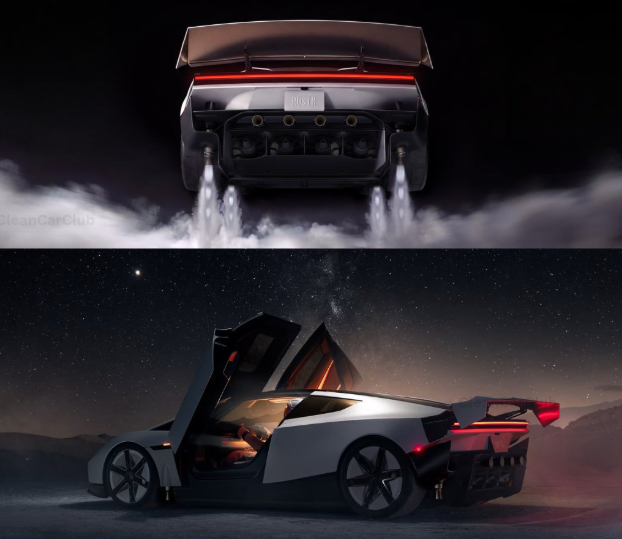
The vehicle was presented on Thursday at a SpaceX test facility in Texas. It was shown climbing a steep ramp, flipping in the air and landing with the help of air jets.
Yet the demonstration left a key question unanswered: can the car sustain flight, or is it capable only of brief aerial jumps?
A Dramatic Product Reveal
The two-seat Roadster was presented as a high-performance vehicle with unusual features. Musk said it could accelerate from zero to 60 miles per hour in less than a second.
During the demonstration, suction was used to help the car climb a steep ramp and remain upside down. It was then propelled into a flip before being brought back down by jets.
No driver was inside the vehicle during the stunt. The precaution was taken, Musk said, to avoid putting anyone at risk.
“Success is not guaranteed,” he told the audience, adding that the demonstration was being conducted from a safe distance.
The car was later shown jumping over a row of parked Tesla vehicles. Jets mounted on the vehicle were also used to demonstrate its rapid acceleration.
How the Flying Roadster Works
Musk said the Roadster uses 10 nozzles and what he described as ultra-high-pressure air tanks. The system is intended to help the car rise into the air and accelerate on the road.
He presented the technology as the product of cooperation between Tesla, the electric-car maker, and SpaceX, the rocket company he also leads.
The vehicle was not shown undertaking sustained or long-distance flight. Its ability to operate as both a road car and an aircraft therefore remains unproven.
Production has been planned for 2028. However, several of Musk’s previous product timelines have been delayed, leaving uncertainty over when the Roadster might reach customers.
Experts Question Whether It Can Truly Fly
The demonstration comes as companies explore electric aircraft capable of taking off and landing vertically. Known as eVTOLs, these vehicles are being developed for uses ranging from air taxis to personal transport.
But combining a road vehicle with an aircraft presents difficult engineering challenges.
Roger Connor, a curator of vertical flight at the Smithsonian’s National Air and Space Museum, told CNN that the demands of cars and aircraft can conflict.
Aircraft must be kept light to fly efficiently. Road vehicles, by contrast, require features such as bumpers and crumple zones to protect occupants during collisions.
A design that attempts to meet both sets of demands could struggle to perform either role well, Connor warned, while also proving expensive.
Other Companies Are Exploring Flying Cars
California-based start-up Alef has also been developing a vehicle designed to take off vertically. Its prototype uses eight propellers, four at the front and four at the rear.
The vehicle is much lighter than a Tesla Roadster and can carry only one person, according to the report.
Alef chief executive Jim Dukhovny said Tesla’s demonstration would not surprise him. Getting a vehicle off the ground, however, is only one part of the challenge.
The harder task is moving safely from vertical lift to forward flight while maintaining stability and sufficient lift, he told CNN.
Connor was similarly cautious about the prospect of a road-legal car travelling through the air wherever its owner wished.
“We’re not talking about sustained flight,” he said. “We are literally talking about hopping.”
The Biggest Test Lies Ahead
Musk’s unveiling offered a striking glimpse of what the Roadster might do. But the event did not establish whether it could fly over meaningful distances or function safely as an everyday road car.
Until further demonstrations and technical details are available, the promise of a flying Tesla remains just that: a promise.