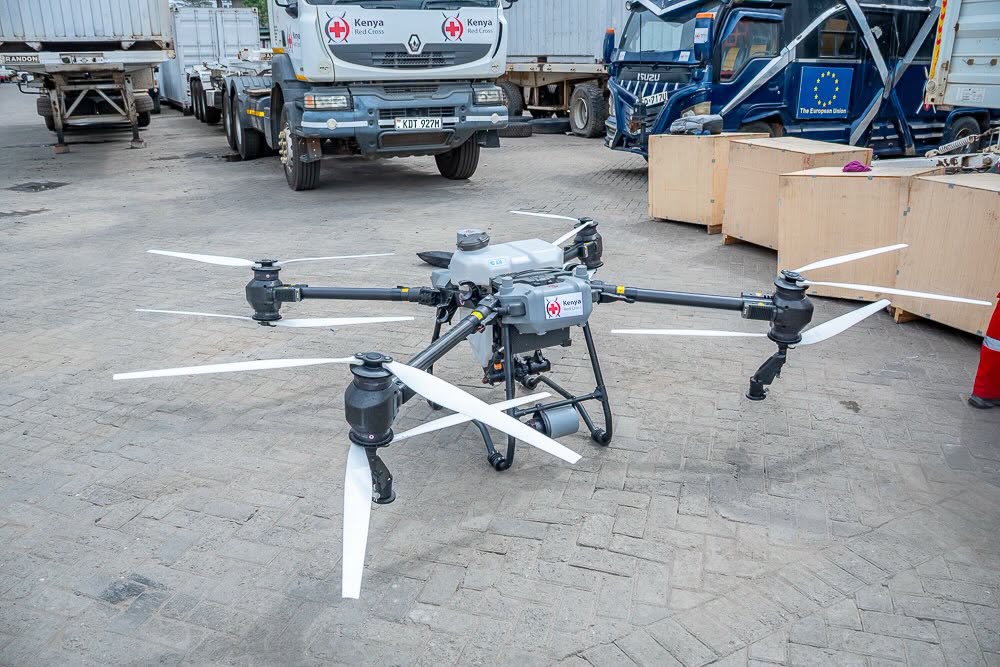
The Kenya Red Cross Society has received a heavy-duty DJI Agras T50 drone and a modified generator from China's Blue Sky Rescue (BSR), boosting its capacity to conduct search-and-rescue operations and deliver emergency assistance to communities affected by disasters.
The equipment will support the humanitarian organisation's drone operations, particularly during floods, landslides, bushfires and other emergencies where damaged infrastructure and inaccessible roads can delay rescue efforts.
In an update shared on its Facebook page, the Kenya Red Cross thanked Blue Sky Rescue for the donation, describing the equipment as a welcome addition to its drone department.
The organisation said the aircraft would provide a faster and safer way to locate people in distress and deliver life-saving supplies, especially in areas cut off from conventional transport.
The donation comes as the Kenya Red Cross expands its use of technology in disaster preparedness and emergency response, including aerial surveillance, mapping and support for rescue teams operating in difficult terrain.
What the DJI Agras T50 can do
The DJI Agras T50 is a large, eight-rotor aircraft originally developed for commercial agriculture. Unlike smaller camera drones, it is designed to lift substantial loads and operate in demanding outdoor environments.
According to Chinese manufacturer DJI, the T50 can carry a 40-kilogram spraying load or up to 50 kilograms of dry materials in its agricultural spreading configuration, under specified operating conditions. These specifications demonstrate the aircraft's lifting capacity, although the weight it can safely carry as emergency cargo will depend on its modifications, altitude and operating conditions.
The drone has a maximum operating speed of 10 metres per second, equivalent to 36 kilometres per hour, and a configurable flight radius of up to two kilometres. Its front and rear radar systems, supported by binocular vision sensors, help it detect obstacles and follow uneven terrain, including slopes.
These features could be useful during floods or landslides, allowing rescue personnel to assess damaged areas from above before sending teams into potentially dangerous locations.
The drone could also assist in transporting emergency medical supplies, communication equipment and other essential items to isolated communities, provided suitable cargo-handling equipment is installed.
However, the standard Agras T50 is not a dedicated search-and-rescue aircraft. Specialist capabilities such as thermal imaging for locating people at night, or controlled release of emergency supplies, would require appropriate additional equipment. The Kenya Red Cross has not publicly detailed the full rescue configuration of the donated aircraft.
The accompanying modified generator could help support operations in areas without reliable electricity by providing power for drone battery charging. DJI's compatible agricultural charging systems can recharge a T50 battery in approximately nine to 12 minutes under suitable conditions, although the specifications of the donated generator have not been confirmed
Building on an existing Kenya-China rescue partnership
The donation follows a partnership formalised on August 5, 2026, between the Kenya Red Cross and Blue Sky Rescue to strengthen emergency response capabilities in the country.
The agreement, signed by Kenya Red Cross Secretary General Dr Ahmed Irshad Idris and Blue Sky Rescue founder Zhang Yong, focuses on developing specialised volunteer search-and-rescue teams, improving technical training and providing emergency equipment.
The collaboration also includes a joint coordination office at Kenya Red Cross headquarters and plans to strengthen rescue capacity at county level.
Blue Sky Rescue recently supported Kenyan emergency responders following the collapse of a multi-storey building in Nairobi's Eastleigh area on October 23.
A two-member Chinese rescue team deployed specialised equipment, including radar life detectors, acoustic sensors and inspection cameras, to help locate people believed to be trapped beneath the rubble. The technology enabled rescuers to focus their search on specific sections of the collapsed structure.
Expanding the use of drones in emergencies
The Kenya Red Cross has previously worked with technology partners to improve disaster response through aerial mapping and surveillance.
During the widespread flooding experienced in Kenya in 2024, the organisation collaborated with Kenya Flying Labs to deploy drones for damage assessment, flood mapping and search-and-rescue support.
The aerial information helped responders identify affected communities, assess damaged infrastructure and prioritise areas requiring assistance, according to a report published by WeRobotics.
The latest acquisition also comes as the Kenya Red Cross seeks additional technological solutions for its October–December 2026 emergency preparedness activities.
In an earlier call for partnerships, the organisation identified drones, geospatial mapping, remote sensing, off-grid power and field connectivity among the technologies needed to strengthen disaster response.
For communities isolated by floods, landslides or damaged roads, the ability to assess conditions from the air and potentially move essential supplies without exposing rescue workers to immediate danger could make a significant difference.
The effectiveness of the new equipment will ultimately depend on the drone's operational configuration, trained personnel, weather conditions and compliance with Kenya Civil Aviation Authority requirements.
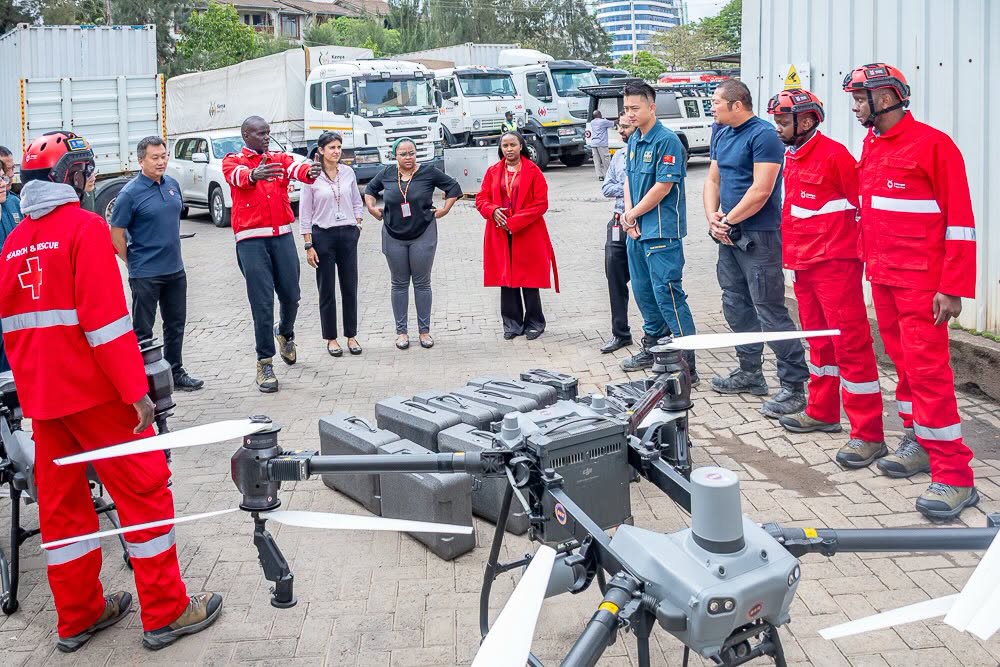
The DJI Agras T50 drone donated to Kenya Red Cross by Blue Sky Rescue China. The heavy-duty aircraft is expected to support disaster assessment, search-and-rescue operations and emergency supply delivery.
Credit: Kenya Red Cross Society