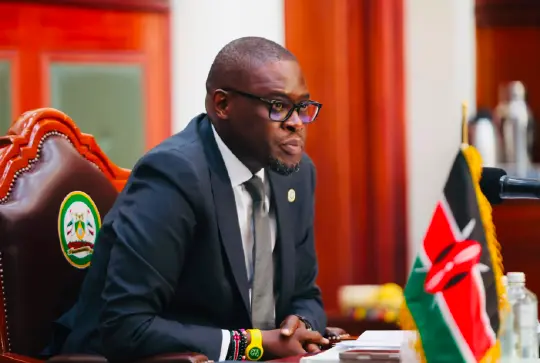
Nairobi Governor Johnson Sakaja has officially abandoned the United Democratic Alliance (UDA) for the Orange Democratic Movement (ODM), declaring his intention to defend his seat on the party's ticket in the 2027 General Election.
Sakaja was formally received into ODM on Monday, November 2, at the party's headquarters, Chungwa House, in Nairobi, ending months of speculation about his political future.
The governor was welcomed by senior party officials, including Deputy Party Leaders Simba Arati and Hassan Joho, National Chairperson Gladys Wanga and National Assembly Minority Leader Junet Mohamed.
His departure from UDA marks a significant political shift ahead of the 2027 elections, particularly in Nairobi, where ODM has maintained a strong political presence.
Speaking during the reception, Sakaja said he was joining the party with experience, energy and a commitment to public service.
"I bring with me the commitment I had to service, experience, energy and conviction that the next phase of politics, the next chapter of our politics must be measured not simply by elections we win but the lives we transform," he said.
He also made clear that his decision was linked to his longstanding relationship with the late former Prime Minister Raila Odinga, whom he described as an important influence on his political journey.
Sakaja said Raila had encouraged him to join ODM and expressed his intention to advance the ideals associated with the former opposition leader.
"If Baba was here today, and he is the one who told me to join ODM, he said that Nairobi should remain bold and we will do everything to ensure that is present in ODM," he said.
Sakaja's relationship with Raila Odinga
The governor's entry into ODM follows years of political cooperation with the party despite his previous membership in UDA.
Sakaja said he had worked closely with Raila even before the formation of the broad-based government arrangement between ODM and President William Ruto's administration.
He recalled facing criticism over his relationship with the former Prime Minister, with some political opponents accusing him of secretly supporting ODM while serving under UDA.
"I was branded an ODM mole even before the Broad-Based Government. I was fought by tribal leaders who opposed my decision to work with Raila," he said.
The governor explained that his cooperation with ODM was partly shaped by the party's influence in Nairobi's political structures.
He argued that working with different political formations was necessary to run the county, particularly given ODM's numerical strength in the Nairobi County Assembly.
His position also reflects the changing relationship between the two parties following the formation of the broad-based government.
Despite leaving UDA, Sakaja maintained his support for the arrangement between the two parties and President Ruto's re-election ambitions.
He said ODM and UDA had settled on Ruto as their presidential candidate for 2027.
"ODM is now in government, and we have one presidential candidate, President Ruto, under our broad-based government arrangement," he said.
The statement places Sakaja's move in a different political context from a conventional opposition defection, with ODM and UDA continuing to cooperate at the national level.
ODM ticket could spark internal contest
Although ODM leaders welcomed Sakaja, his entry into the party does not automatically guarantee him the gubernatorial ticket.
The governor faces a potentially difficult nomination process, with several party members already expressing interest in the Nairobi seat.
Among them is Makadara MP George Aladwa, who has openly indicated his intention to contest for governor on an ODM ticket.
In September, ODM delegates from Nairobi rejected proposals to hand Sakaja the party's nomination without a competitive process.
The delegates, who met in Makadara, resolved to support Aladwa and argued that long-standing party members should not be sidelined in favour of politicians defecting from other parties.
They called for a transparent nomination process and maintained that ODM should give its existing members an opportunity to compete for the party's ticket.
Aladwa also supported the position, insisting that politicians seeking elective positions should participate in the party's nomination process.
Responding to the question of internal competition, Sakaja said he intended to engage Aladwa and other party leaders to find common ground.
"I will also meet Aladwa, who has expressed interest in vying for governor on the ODM ticket, and we will engage, agree and reach a conclusion," he said.
Arati, meanwhile, assured party members that ODM would provide an opportunity for all interested candidates.
"We will give everyone an opportunity, and our nominations will be free and fair," he said.
The question of whether ODM's existing political structures will rally behind Sakaja or favour one of their long-standing members is likely to shape the party's preparations for the Nairobi contest.
Babu Owino and Karauri emerge as key challengers
Beyond ODM's internal politics, Sakaja faces competition from other politicians seeking to take control of City Hall.
Embakasi East MP Babu Owino has declared his interest in the Nairobi governorship under The Mwananchi Party, following his political differences with ODM.
Owino has defended his ambition by pointing to his parliamentary record and arguing that his experience in managing Embakasi East demonstrates his ability to lead the county.
He has also criticised the current county administration, particularly over the handling of service delivery and the cooperation framework between Nairobi County and the national government.
Kasarani MP Ronald Karauri has also declared his intention to contest the Nairobi governorship.
Karauri has cited building collapses, poor urban planning, drainage problems and flooding as some of the challenges he wants to address if elected.
Following Sakaja's defection on Monday, Karauri criticised the governor, arguing that changing political parties would not shield him from scrutiny over his record at City Hall.
"Sakaja won Nairobi on a UDA ticket. He's not leaving UDA because of any problem with the party - he's running to ODM because he thinks a new colour will make people forget his record," Karauri wrote.
He also cited collapsed buildings, flooding, garbage collection and unpaid bursaries as issues he believes the governor should answer for.
His remarks introduce service delivery and accountability into the political debate surrounding Sakaja's second-term ambitions.
Sakaja's administration has faced scrutiny over several urban management challenges, while the governor has maintained that his government is working to improve services and coordinate with the national government.
Why Nairobi matters to ODM
Sakaja's decision also carries significance for ODM's political influence in the capital.
The party has a substantial political network in Nairobi, including elected representatives and grassroots structures across the county's 17 constituencies.
During Sakaja's reception, Junet Mohamed said the party's electoral strength in the previous election had positioned it to expand its representation in the capital.
He argued that bringing a sitting governor into ODM would strengthen the party's presence in Nairobi.
Wanga also welcomed the move, describing Nairobi as an ODM stronghold and pledging the party's support for the governor.
For Sakaja, the party offers access to an established political network as he prepares to seek another term.
However, the strength of that network will not necessarily translate into automatic support for his candidacy, particularly with sections of ODM's membership having already backed Aladwa.
Sakaja's 2022 election victory
Sakaja was elected Nairobi Governor in August 2022 on a UDA ticket after defeating former Jubilee candidate Polycarp Igathe.
He secured 699,392 votes against Igathe's 573,518, becoming the fourth governor of Nairobi County.
His victory came after serving as Nairobi Senator, a position he held before entering the gubernatorial race.
The 2027 election will therefore test whether he can retain the support that carried him to City Hall, this time under a different political party.
His latest move gives him a new political platform, but it also places him in the middle of ODM's internal competition and an increasingly crowded gubernatorial race.
With the election approaching, Sakaja will have to defend his record in office, consolidate support within ODM and convince Nairobi voters that he deserves another term.