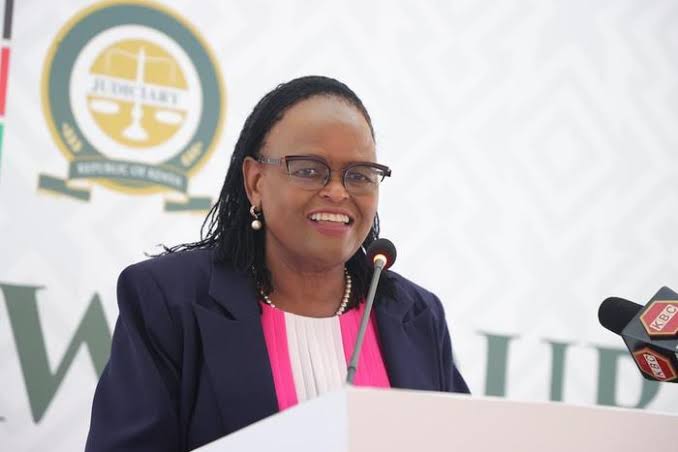
Chief Justice Martha Koome has disclosed how public land belonging to the Judiciary was taken over by private individuals, leaving even Kenya's highest court without formal proof of ownership.
The Supreme Court premises in Nairobi were among the properties affected. The ownership dispute has now been addressed, with three title deeds handed over to the Judiciary in a development seen as an important step in securing public institutional land.
The documents cover the Supreme Court premises, a neighbouring parking lot and Kapsabet Courts.
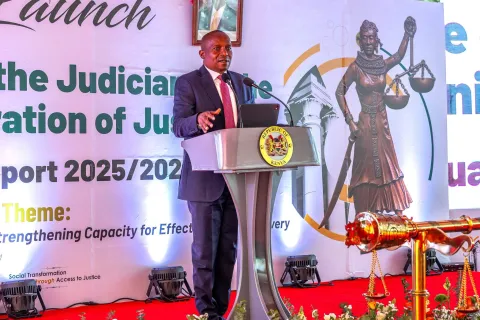
Speaking on Friday, November 20, during the launch of the 12th State of the Judiciary and Administration of Justice Annual Report for the 2025/2026 financial year, Koome said the property had been recovered last year following President William Ruto's intervention.
Koome recounts Supreme Court land dispute
The Chief Justice said those who had taken over the property had challenged the Judiciary to pursue the matter through the courts.
"Some people have no shame. They had even grabbed our Supreme Court land and told us to go to court, asking us which court we would go to," Koome said.
She credited President Ruto with helping to secure the property's recovery, adding that the handover of the title deeds marked an important milestone for the institution.
"Today, we are here to celebrate the title deed for our plot, including the title deed for the Supreme Court, which previously had no title," she added.
The ceremony was attended by Lands Cabinet Secretary Alice Wahome, who formally presented the three documents.
Wahome confirms three title deeds
Wahome confirmed that the documents covered the Supreme Court premises, a parking lot and Kapsabet Courts. She revealed that commercial activities had previously been conducted on the parking lot, including the operation of a private parking business.
"There were people conducting business on that land, including operating a parking business," Wahome said.
The Lands Cabinet Secretary said the government had been surprised to discover that the Supreme Court had been operating without a title deed for the land it occupies.
"We were shocked that the Supreme Court itself did not have a title deed for the land on which it sits," she said.
The handover followed concerns that had been raised over the Judiciary's ownership documents and the protection of land reserved for its operations.
Land dispute dates back to 2015
The dispute over Judiciary land had previously been brought before Parliament. In May 2015, former Chief Registrar of the Judiciary Anne Amadi told the National Assembly's Justice and Legal Affairs Committee that a parcel next to the Supreme Court had been taken over and registered in a private individual's name.
The property had reportedly been reserved for the expansion of the country's highest court. At the time, the land was being used by the Maasai Market. Amadi told MPs that earlier efforts to recover it had not succeeded.
The matter returned to the spotlight in November 2025, when Deputy President Kithure Kindiki directed Wahome to ensure that the Supreme Court received its title deed before Christmas.
The directive followed concerns raised by Koome over the absence of formal ownership documents. The latest handover therefore marks the conclusion of a process that had remained unresolved for years.
Judiciary clears more cases than it receives
Beyond the land issue, the annual report presented during the ceremony showed progress in the resolution of court cases.
A total of 576,702 cases were concluded during the 2025/2026 financial year, against 561,580 new cases filed. This translated into a case clearance rate of approximately 103 per cent. It was the second consecutive year in which more cases were resolved than received.
The overall pending caseload stood at 579,954 by June 30, 2026. Cases that had remained unresolved for more than one year declined by 15.8 per cent, falling from 405,486 to 341,412.
However, the improved figures were not presented as evidence that the backlog had been eliminated. Thousands of Kenyans are still waiting for their disputes to be determined.
Staff shortages continue to affect services
The report also highlighted staffing shortages as a major obstacle to the delivery of justice. By June 30, 2026, the Judiciary had 8,017 employees against an approved establishment of 12,079. This represented approximately 66 per cent of the required workforce.
The shortage has continued to place pressure on court operations, with magistrates, registrars and other judicial personnel among the affected cadres. The absence of witnesses was also identified as a major cause of adjournments, contributing to delays in the determination of cases.
Despite these challenges, efforts have been made to expand access to justice beyond major towns. Two additional Court of Appeal stations were established in Kakamega and Meru. The number of magistrates' courts also increased to 148, while tribunals rose to 28.
Mobile justice services set for Nairobi
The Judiciary is also preparing to introduce a mobile justice truck aimed at bringing court services closer to communities. The vehicle is scheduled to begin operations in Nairobi on December 1, targeting densely populated, low-income neighbourhoods where access to conventional court services can be difficult.
Chief Registrar of the Judiciary Winfridah Boyani Mokaya said the initiative was intended to reduce the distance between citizens and judicial services.
"We want to take justice beyond the courtroom and bring services closer to the people," Mokaya said.
The initiative is expected to ease pressure on established court stations while giving more residents access to essential judicial services. For the Judiciary, the title deed handover and the planned expansion of services represent two important priorities: protecting public property and making justice more accessible to Kenyans.