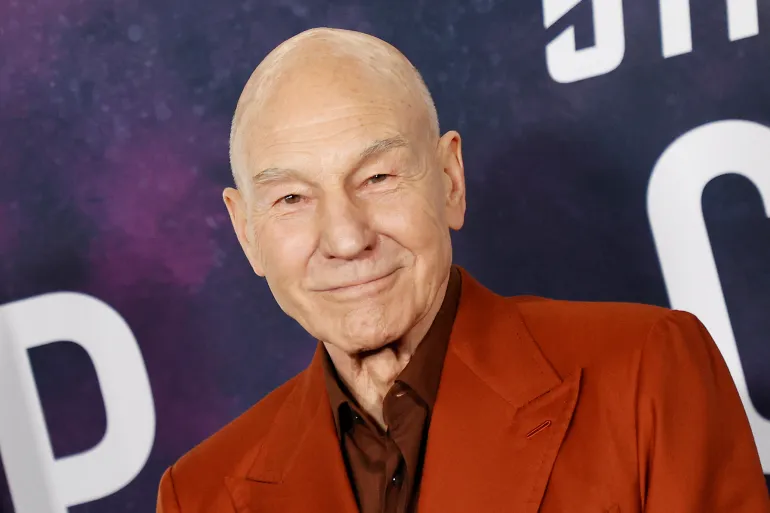
British actor Sir Patrick Stewart, whose commanding performances made him a household name through Star Trek and the X-Men film franchise, has died aged 86.
Stewart died on Wednesday, October 28, in Los Angeles following a battle with Alzheimer's disease and Lewy body dementia, his spokesperson Kelly Bush Novak announced on Thursday.
His death marks the end of a remarkable career that spanned more than six decades, taking him from Shakespearean theatre to some of the most recognised science fiction productions in film and television.
Stewart became internationally recognised for portraying Captain Jean-Luc Picard in Star Trek: The Next Generation, which premiered in 1987 and ran for seven seasons.
His portrayal of the thoughtful and disciplined starship commander helped establish him as one of the franchise's most recognisable figures. His famous command, "Make it so", became closely associated with the character.
He later gained another generation of fans through his role as Professor Charles Xavier, also known as Professor X, in the X-Men films. He first appeared in the role in 2000, sharing the screen with Hugh Jackman, who played Wolverine.
A career built on Shakespeare
Beyond his success on screen, Stewart was an accomplished theatre actor whose career was deeply rooted in classical drama.
He spent 14 years with the Royal Shakespeare Company, performing in productions of several of William Shakespeare's works, including Macbeth, Hamlet and King Lear.
His stage performances also included a one-man adaptation of Charles Dickens' A Christmas Carol and productions of Harold Pinter's No Man's Land and Samuel Beckett's Waiting for Godot.
The latter brought him together with longtime friend and fellow actor Ian McKellen.
In 2008, Stewart received a Tony Award nomination for his performance in Macbeth, earning praise for bringing a deeply human dimension to the tragic character.
Reflecting on the role in an interview with the Associated Press, Stewart said he had first memorised Macbeth's soliloquies as a teenager because he admired the writing.
His eventual performance was one of the most celebrated stage appearances of his career.
From working-class Yorkshire to Hollywood
Born on July 13, 1940, Stewart grew up in Mirfield, West Yorkshire, in northern England.
His upbringing was modest. His childhood home did not have an indoor bathroom, and he developed an interest in acting while still young.
He joined an amateur drama group at the age of 12 before pursuing formal training at Bristol Old Vic Theatre School.
Stewart also spoke publicly about growing up in a home affected by domestic violence. His father, a former British Army senior non-commissioned officer, subjected his mother to repeated abuse.
He later used his public platform to speak against domestic violence and became a patron of Refuge, a charity supporting survivors of abuse.
His contribution to the arts was recognised in 2010 when Queen Elizabeth II knighted him for his services to drama.
A lasting legacy
Although Stewart became globally associated with science fiction, his career extended well beyond the genre.
He appeared in numerous stage productions, films and television programmes, demonstrating an ability to move between classical drama, comedy and blockbuster cinema.
His portrayal of Captain Picard also returned to television through Star Trek: Picard, which concluded its third and final season in 2023.
His death comes just days after the passing of fellow Star Trek actor Walter Koenig, who portrayed Pavel Chekov in the original television series.
Stewart leaves behind a legacy that connects generations of theatre audiences, television viewers and film fans.
For many, he will remain the calm and commanding Captain Picard. For others, he will be remembered as Professor X, the wise leader of the X-Men.
But beyond those celebrated characters was a classically trained actor whose dedication to the stage helped shape one of the most distinguished careers in British entertainment.