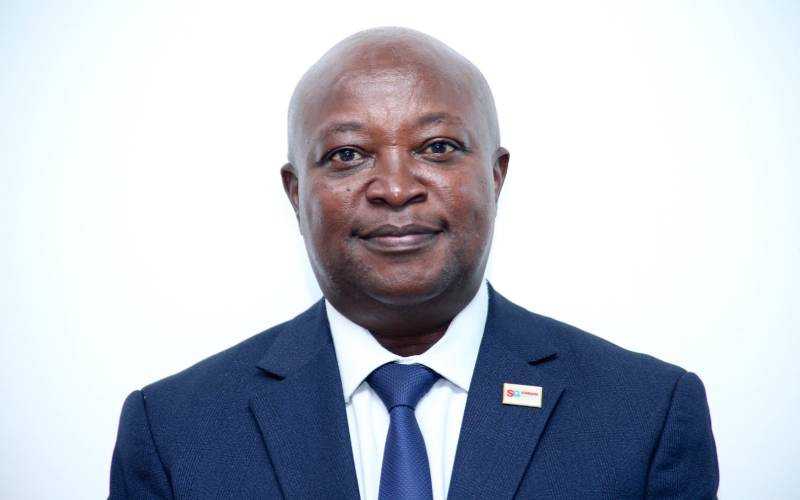
Chaacha Mwita's departure raises fresh questions about leadership stability at one of Kenya's oldest media houses, where years of financial losses, declining advertising revenues and unresolved employee claims have overshadowed efforts to turn the business around.
NAIROBI, Kenya, October 16, 2026 — The Standard Group Plc is facing renewed scrutiny over its financial health and treatment of employees following the resignation of Chief Executive Officer Chaacha Mwita, barely seven months after his confirmation as the substantive head of the troubled media company.
Mwita's resignation, announced on Friday, will take effect on November 1, 2026. He will also relinquish his position as an executive director of the Nairobi Securities Exchange-listed company.
In a regulatory notice, the board confirmed his departure but did not disclose the reasons behind the decision or immediately announce a successor.
His exit comes at a particularly difficult moment for the publisher of The Standard newspaper and operator of KTN and Radio Maisha, whose financial difficulties have increasingly spilled into its workforce, leadership structures and relationships with former employees.
For hundreds of journalists, technicians, producers, editors and other employees who have faced delayed salaries or have left the company while pursuing outstanding dues, the leadership change raises a more immediate question: Will another change at the top finally deliver the money they are owed?
A revolving door at the top
Mwita was confirmed as substantive CEO on April 1, 2026, after serving in an acting capacity from July 2025.
He succeeded Marion Gathoga-Mwangi, who announced her departure in June 2025 after less than a year in the position, citing personal circumstances.
The latest resignation therefore continues a period of significant executive turnover at a company struggling to restore financial stability.
The leadership uncertainty extends beyond the chief executive's office.
On October 12, the company announced the resignations of non-executive directors Edward Mwasi and Dr James McFie, effective August 31, 2026. Another independent director, Michael Lusiola, had departed in August.
The group has subsequently appointed Anthony Ambaka Kegode, Tom Odongo and Elishah Njeru as independent non-executive directors, effective October
Although board and executive departures do not automatically indicate corporate mismanagement, their frequency is significant for a company attempting a difficult turnaround.
Leadership transitions can interrupt restructuring programmes, delay investment decisions and complicate negotiations with creditors, advertisers and employees.
The company has not publicly established that Mwita's resignation was caused by its financial problems, and it would be premature to attribute his departure directly to the salary crisis.
The human cost: Employees working without regular pay
Behind Standard Group's financial statements lies a prolonged labour dispute involving current and former workers.
In November 2024, former employees publicly protested outside the company's Mombasa Road headquarters, demanding unpaid salaries, redundancy benefits, severance packages and savings they said had not been remitted.
According to Citizen Digital, the former employees said more than 400 people were affected.
Some complained that they had been waiting for their money long after leaving the company, while others raised concerns about deductions made from their salaries for statutory contributions, pension arrangements and cooperative savings.
The employees accused the company of failing to honour payment commitments. Management, then led by Marion Gathoga-Mwangi, acknowledged payment delays and announced plans for structured engagement with affected former workers.
However, some of the former employees disputed the company's account of those engagements.
These disputes expose a serious distinction between a company temporarily struggling to meet its monthly payroll and one carrying unresolved employment liabilities accumulated over several years.
For affected workers, unpaid salaries can mean rent arrears, defaulted loans, disrupted education for their children and mounting household debt.
Unremitted deductions, where substantiated, create an additional concern because the money may have been withheld from employees' earnings for a designated purpose.
The historical complaints are well documented. However, the precise number of employees still owed money, the total outstanding amount and the status of individual claims as of October 16, 2026, require updated confirmation from the company, workers' representatives and relevant institutions.
Eight months of salary arrears: How the crisis accumulated
The scale of the payroll crisis became particularly clear in November 2024, when employees said they were owed eight months of salary arrears spanning two financial years.
According to a statement reported by Kenyans.co.ke, the outstanding months were June, July and August 2023, followed by March, April, May, June and July 2024.
The workers also said employees affected by the July 2024 redundancy programme had been promised payments over 12 months, but the initial instalments had not materialised as scheduled.
The company had announced plans to eliminate more than 300 positions as part of restructuring, citing a difficult business environment and the need to reduce operating costs.
This history matters because the problem was not simply a single missed payroll. Employee accounts described an accumulation of arrears over successive financial periods.
In some cases, workers reported receiving partial salary payments while unpaid balances continued to accumulate.
Such arrangements may temporarily keep operations running, but they can also turn wages into an informal source of financing for a struggling employer.
Instead of obtaining additional capital from shareholders, lenders or investors, a business effectively delays payments to people who have already provided their labour.
That interpretation is a financial analysis of the reported payment pattern, rather than evidence of a deliberate policy adopted by Standard Group's management.
What is really ailing Standard Group?
FINANCIAL ANALYSIS
The company's own published financial statements offer important clues about why its problems have persisted despite repeated restructuring initiatives.
2024 annual net loss
KSh 1.10B
Consolidated group resultH1 2025 net loss
KSh 133M
Six months to June 2025H1 2025 revenue
KSh 789M
Approximately 24% lower year-on-yearJune 2025 total equity
−KSh 2.36B
Negative shareholders' equity1. Advertising revenue is shrinking faster than the traditional business can adjust
Standard Group's 2025 half-year results showed a revenue decline of approximately 24%, attributed largely to reduced advertising revenue and slower government contracts.
This is a structural challenge affecting traditional media houses across Kenya.
Advertisers who previously relied heavily on newspapers, television and radio can now direct spending towards digital platforms offering targeted advertising, measurable conversions and flexible budgets.
For a media company maintaining expensive broadcast infrastructure, printing operations, distribution networks and large newsrooms, falling revenue creates a serious mismatch between income and fixed costs.
The challenge is not necessarily that audiences have stopped consuming news. Rather, audiences increasingly consume journalism through platforms where traditional publishers do not capture the same proportion of advertising revenue.
Standard Group itself acknowledged changing consumer behaviour, digital competition and rising operating costs as principal risks in its 2024 annual report.
2. Years of accumulated losses have weakened the balance sheet
The company's 2024 accounts reported a consolidated loss of approximately KSh 1.10 billion.
By June 2025, total shareholders' equity had fallen to negative KSh 2.36 billion.
Negative equity means the accounting value of a company's liabilities exceeds its assets.
It does not automatically mean that a business is bankrupt or unable to continue trading. However, it indicates that accumulated losses and obligations have substantially eroded the capital available to absorb further financial shocks.
Consolidated losses in KSh millions; periods are not directly comparable.
Although the much smaller half-year 2025 loss suggests cost-cutting measures were having an effect, the company remained loss-making.
More importantly, an improvement in the income statement does not necessarily mean that old salary arrears, creditor balances and statutory liabilities have been settled.
A company can reduce its current operating losses while still carrying substantial unpaid obligations from previous years.
3. Unpaid government advertising bills have intensified cash-flow pressure
The Standard Group has publicly attributed part of its financial difficulties to delayed government payments.
In its half-year 2025 financial report, the company said a government debt backlog extending more than seven years had constrained its operations.
The group also identified slower government contracts as a contributor to declining revenue.
This creates a particularly difficult cash-flow problem.
A media company may recognise revenue after delivering advertising services, yet receive the actual payment months or years later.
Meanwhile, journalists, engineers, suppliers, landlords and lenders require cash payments.
The gap between revenue recognised and cash collected can become financially destabilising.
However, government debt cannot fully explain Standard Group's difficulties. Its financial statements also point to falling commercial advertising, operating costs, accumulated losses and broader industry disruption.
The precise share of unpaid staff dues attributable to delayed government payments cannot be established from the available public disclosures.
4. Restructuring has reduced costs without eliminating legacy liabilities
Standard Group has repeatedly attempted to reduce expenditure through redundancies, operational restructuring and a leaner organisational model.
Its 2025 half-year financial statement reported a 26% reduction in overhead costs.
That is evidence of substantial cost containment.
But layoffs can create immediate financial obligations, including notice pay, accrued leave, severance and outstanding wages.
If a company cannot finance these payments, restructuring may reduce future payroll expenditure while leaving behind a large pool of former employees demanding settlement.
That appears consistent with the pattern described in Standard Group's publicly reported labour disputes.
The business therefore faces two simultaneous obligations: financing its remaining operations and settling debts owed to people who have already left.
5. A capital injection has remained central to the turnaround plan
The group has pursued a proposed KSh 1.5 billion rights issue as part of its recapitalisation strategy.
A rights issue allows existing shareholders to purchase additional shares, potentially providing fresh capital without relying exclusively on borrowing.
Standard Group's stated recovery plans have included debt restructuring, strengthening working capital, digital expansion and supporting new revenue streams.
However, the proposed rights issue has faced delays, and its intended proceeds should not be treated as cash already available to pay workers.
Even if the company raises the full amount, the board would still need to balance competing demands from employees, statutory agencies, lenders, suppliers and operational investment.
A capital injection would improve liquidity, but it would not by itself guarantee a sustainable turnaround unless the core business can consistently generate sufficient cash.
6. Regulatory debts have added another layer of risk
In 2026, Standard Group faced a further challenge over outstanding broadcasting licence fees.
Business Today reported that the Communications and Multimedia Appeals Tribunal had upheld regulatory action involving approximately KSh 48.87 million in unpaid licence fees and Universal Service Levy obligations affecting six broadcasting platforms.
This is especially significant for a broadcaster.
Regulatory liabilities can threaten the licences required to operate revenue-generating television and radio services.
A company facing potential interruption of its broadcasting operations may also find it harder to reassure advertisers, negotiate financing and implement a long-term recovery plan.
The tribunal dispute does not, on its own, establish the present operational status of each broadcasting licence.
Even former chief executives have pursued unpaid dues
The dispute over unpaid employment benefits has not been confined to junior or mid-level staff.
Former Standard Group chief executive Orlando Lyomu pursued the company through the courts over outstanding employment dues.
In 2025, the Employment and Labour Relations Court dealt with enforcement of an award initially valued at approximately KSh 38.34 million, covering salary arrears, notice pay, leave and other contractual entitlements.
According to The Kenyan Wall Street, the dispute included disagreements over compliance with a court-approved instalment arrangement.
The case illustrates the breadth of the company's employment-related liabilities.
In another case, Okullo v Standard Group Plc [2025] KEELRC 2525 (KLR), former commercial executive Jackline Atieno Okullo pursued claims involving unpaid employment benefits.
Court records show that the dispute included a claim for approximately KSh 3.12 million in terminal dues, alongside litigation concerning salary arrears. The proceedings also raised procedural questions about overlapping claims in different courts.
These cases do not establish the current outstanding balance owed to every former employee. They do, however, demonstrate that disputes over unpaid employment obligations have reached the courts and involve substantial amounts.
Why have former employees struggled to recover their money?
The central problem appears to be a combination of insufficient financial resources, accumulated liabilities and delayed settlement arrangements.
A company experiencing a severe liquidity shortage may acknowledge that it owes workers money without having sufficient immediately available cash to discharge every obligation.
But financial distress does not extinguish contractual or statutory employment rights.
Under Kenya's Employment Act, employers have obligations concerning payment of wages, termination of employment and redundancy procedures. Section 40 specifically governs redundancy, including applicable severance requirements.
Where deductions have been made from employees' salaries, the handling and remittance of those amounts may also create separate statutory or contractual obligations.
The distinction is important: salary arrears, severance pay, pension contributions, SACCO savings and statutory deductions are not necessarily interchangeable debts. They may be owed to different beneficiaries and governed by different legal mechanisms.
For Standard Group, the unresolved issue is whether its restructuring and financing plans include a transparent, adequately funded programme for settling all verified employee liabilities.
Without a published reconciliation of those debts and a credible payment timetable, affected employees have limited visibility into when they might receive their money.
Can Standard Group recover?
The company still possesses valuable media assets, established news brands, professional expertise and an audience built over decades.
Its 2025 half-year results also showed that cost reductions had improved financial performance compared with the corresponding period in 2024.
Those are potential foundations for recovery.
However, a sustainable turnaround would require more than appointing another chief executive or implementing additional layoffs.
The company would need to restore predictable cash flow, stabilise its commercial revenue, manage regulatory and creditor obligations, and demonstrate that it can meet its payroll while progressively settling historic liabilities.
Digital transformation will also be essential, but simply transferring television and newspaper content onto social media platforms is unlikely to replace lost advertising revenue automatically.
New revenue models may include digital subscriptions, commercial video production, licensing, events, branded content and other services that capitalise on the group's existing editorial and production capabilities.
Each would require a clear commercial strategy, investment discipline and credible financial projections.
Most importantly, any recovery plan must address the workforce. A media organisation depends on journalists, producers, editors, technical teams and commercial staff to deliver the content and services that generate revenue.
Prolonged payment uncertainty risks accelerating the departure of experienced employees, weakening institutional knowledge and making recruitment more difficult.
Questions the board must answer
Mwita's resignation leaves several important issues unresolved.
-
Outstanding staff dues: How much does Standard Group currently owe serving employees and former workers in salaries, severance, pension contributions, SACCO savings and other benefits?
-
Payment commitments: How many employees have received full or partial settlements, and what timetable exists for the remaining verified claims?
-
Recapitalisation: What is the current status of the proposed KSh 1.5 billion rights issue, and how much of any eventual proceeds would be allocated to employment liabilities?
-
Leadership: Why is the company experiencing repeated senior leadership departures, and what continuity measures are in place for its turnaround programme?
-
Financial recovery: What progress has been made in collecting overdue advertising debts, resolving regulatory obligations and generating sustainable digital revenue?
These are matters of legitimate public interest for a listed company with shareholders, creditors, employees and audiences who depend on its continued operations.
Beyond the resignation: A test of accountability
Chaacha Mwita's departure is the latest development in a much longer struggle at one of Kenya's most recognisable media institutions.
The company's difficulties reflect a combination of structural disruption in the media industry, declining traditional advertising revenue, accumulated financial losses and persistent cash-flow pressures.
But the unresolved employee claims add a distinct human and governance dimension to the crisis.
For workers who have gone months without salaries and former employees who have pursued their dues through protests and legal proceedings, corporate recovery cannot be measured by financial restructuring announcements alone.
It must also be measured by whether obligations to employees are honoured.
As Standard Group prepares for another leadership transition, the central challenge is therefore not simply who will replace Mwita.
It is whether the company's board and shareholders can deliver a credible financial recovery that restores operational stability while providing a transparent and enforceable path to settling the debts owed to the people who helped build the organisation.
Until those questions are answered, the resignation will remain only one chapter in a much larger story about the future of Kenya's traditional media industry.