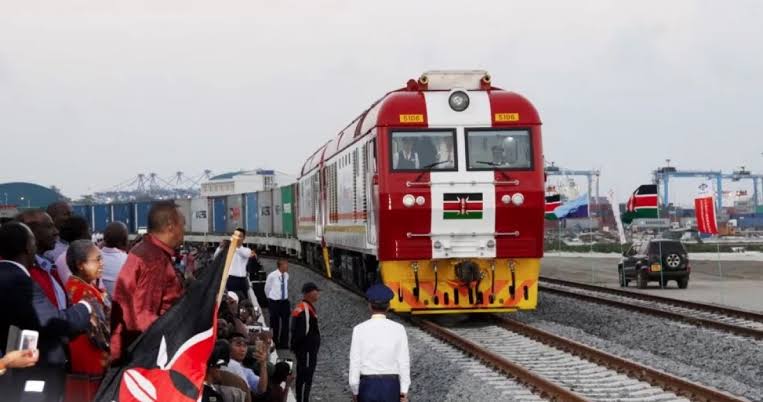
Kenya’s Standard Gauge Railway (SGR) could have cost taxpayers up to KSh117 billion less if its construction had matched the cost per kilometre of a comparable railway in Tanzania.
The estimate has been highlighted in the World Bank’s 34th Kenya Economic Update, released on November 4, 2026. It raises fresh questions about how major public projects are procured, financed and supervised.
The report identifies corruption and weak governance as major obstacles to Kenya’s economic progress. It argues that public money is being lost through costly contracts, poor oversight and irregularities in the management of public resources.
How the SGR Costs Compare
The Mombasa–Nairobi section of Kenya’s SGR was estimated to have cost about KSh988 million per kilometre. The line is diesel-powered and covers approximately 472 kilometres.
By comparison, Tanzania’s electrified Dar es Salaam–Dodoma railway was estimated to have cost KSh740.8 million per kilometre. The electrified Djibouti–Addis Ababa railway was put at about KSh689 million per kilometre.
Using Tanzania’s cost per kilometre as a benchmark, the World Bank estimates that up to US$900 million, equivalent to about KSh117 billion, could have been saved during the initial construction phase.
The comparison does not mean the two projects were identical. Differences in engineering, terrain and other project requirements must be considered. However, the World Bank says these factors do not fully explain Kenya’s higher costs.
Procurement and Land Deals Under Scrutiny
At least 30 per cent of the cost difference was attributed by the World Bank to governance challenges rather than technical or geographical factors.
These included the preference for direct contracting over competitive tendering, land speculation and alleged fraud involving land titles, property valuations and compensation payments.
The initial Mombasa–Nairobi railway was constructed by China Road and Bridge Corporation (CRBC). The contractor also carried out the project’s feasibility study, with approval from Kenya Railways Corporation.
The project was financed through loans from China Exim Bank. About KSh649.9 billion was borrowed through three facilities in 2014 and 2015 to fund construction of the railway and its subsequent extension towards Naivasha.
The loan agreements and other project records have remained subjects of public scrutiny. In May 2026, the Court of Appeal rejected the State’s attempt to keep the agreements secret.
The Port of Mombasa Also Faces Challenges
The SGR was not the only infrastructure project examined in the World Bank’s assessment.
The Port of Mombasa was also flagged over inefficiencies that increase transport costs and weaken Kenya’s competitiveness. Multiple inspections and corruption risks were identified as concerns affecting the movement of goods.
The port was ranked 375th out of 403 ports in the World Bank’s 2024 Container Port Performance Index. Its position had fallen from 326th out of 348 ports assessed in 2022.
Multiple weighbridge stops and police checks were also identified as obstacles affecting transport and trade.
High Electricity Costs Add to the Burden
The cost of electricity was another concern raised in the report.
Kenyan businesses were found to pay substantially more for power than their counterparts in some comparable economies. Rates were reported to be more than twice those in Vietnam and nearly 50 per cent higher than in Uganda.
The World Bank linked the price gap partly to weaknesses in the awarding and management of Power Purchase Agreements (PPAs). Limited competition, non-transparent contracts and potential conflicts of interest were identified as factors that could favour more expensive electricity deals.
These costs are passed on to businesses and consumers, affecting production expenses, household budgets and Kenya’s ability to compete with other economies.
World Bank Calls for Governance Reforms
The wider economic update estimates that corruption and collusion contribute up to two percentage points of GDP to Kenya’s annual fiscal deficit. The resulting pressure increases borrowing needs and leaves fewer resources available for essential public services.
The World Bank has called for stronger fiscal discipline, transparent procurement and disclosure of beneficial ownership. Improvements in tax and customs administration have also been recommended.
The institution estimates that stronger governance could raise Kenya’s GDP by up to 20 per cent by 2035 and support 7.7 million additional and better-quality jobs.
The government has pointed to measures such as digitised procurement, conflict-of-interest legislation and more predictable payments to contractors as part of its response to governance concerns. Treasury Principal Secretary Chris Kiptoo welcomed the report’s recommendations, although he maintained that the government expected growth of at least 5 per cent in 2026.
A Question of Value for Money
The SGR comparison has renewed debate over whether Kenya received value for money from one of its largest infrastructure investments.
The estimated KSh117 billion saving is a comparison based on Tanzania’s construction costs. It is not a finding that the entire amount was stolen or lost through corruption. The World Bank attributes at least 30 per cent of the cost difference to governance-related factors.
The wider challenge is to ensure that future public projects are awarded competitively, properly supervised and delivered at fair costs. Without stronger accountability, the benefits of major infrastructure spending may continue to be reduced by inefficiency and poor public financial management.